[ Posted Friday, January 14th, 2011 – 17:11 UTC ]
To honor the fallen this week, we're going to refrain from our usual heated political rhetoric here for a change. It's only fitting, really, after such an emotional week for America. So, just to warn everyone up front, we're not going to be heaping our usual amounts of scorn on Republicans this week. Instead, we're going to (briefly) heap some scorn on the mainstream media, and then after a foreshortened awards section, we are going to reprint the text of President Obama's moving speech in Tucson this Wednesday, for those of you who haven't had the chance to view it or read it.
But before we get to that, one thing must be addressed first. In all the media I've been exposed to in the past week, I've noticed something. While there has been a frenzy of finger-pointing and blame assigned by the mainstream media, in an attempt to attach some sort of meaning to the murderous rampage Saturday, there has been precious little said about the role of the media itself.
Continue Reading »
[ Posted Thursday, January 13th, 2011 – 18:15 UTC ]
For those of you who still feel it is "too soon" after the Tucson tragedy to discuss such a crass subject as politics, I would strongly advise just skipping the rest of this column, because it's only going to annoy you. I have not yet discussed any of the political ramifications from last Saturday's shooting rampage, which (as it turned out) was probably a wise choice, because we've all had a bit too much of that sort of thing already by this point. Giant logical leaps to the Land of Conclusion have been happening pretty steadily since the news first broke, and many of these did not have soft landings (to put it mildly). It's always risky to attempt to draw any conclusions by extrapolating from a very tiny set of data (or a single data point, at times), because predicting trends is an almost impossible task from such shaky ground. And when there simply is no data available, pontificating about "what it all means" becomes downright dangerous, since it is no more than wild speculation (which usually leads to what the psychiatrists call "projection" -- ascribing your own thoughts and views upon the subject at hand). Which, as we've seen all week, can lead to some spectacular backfires. But having said all of that, I am about to engage in exactly what I've just warned everyone else not to do -- identify a trend from mere shreds of data. So, up front (and with apologies to Emile Zola, of course), I'd just like to pre-emptively say: "Je m'accuse!"
Continue Reading »
[ Posted Wednesday, January 12th, 2011 – 19:22 UTC ]
Roughly once a year or so, I turn this column space over to a guest author. This usually happens when a point of view is presented to me either in public comments or private emails which has impressed me. I haven't always completely agreed with these points of view, but have thought that they deserved a wider audience because the writing was so thoughtful and the reasoning so impressive. Other times, I do heartily agree with the guest author. But sometimes the author writes on subjects which I don't feel qualified myself to tackle. Today, I am once again turning my column over to a group of three authors who have a point to make -- a point that lies mostly outside my experience, which is why I don't comment on it very often: the state of education in America, and how politics relates to it.
The first of the authors of the following piece is well-known to us here, as he was one of the first guest authors to ever appear in this column. Joshua Eisenstein, Ph.D., took me to task during the 2008 Democratic primary season for writing an article suggesting "How Obama Could Wrap It Up". Eisenstein challenged me to write a companion article about Hillary Clinton, but his comments and suggestions as to how to write such an article impressed me so much that I invited him to write his own column, "How Hillary Could Win Fair (And Lock Up The General Election Too!)" -- which is still worth reading for his excellent point of view.
Campaign season aside, though, Eisenstein recently challenged me once again to write about President Obama and his "Race To The Top" education policy, after the release of the movie Waiting For Superman. Eisenstein is not only a doctor of educational psychology but also a civics teacher in a large public school district, so he had a much more experienced take on the subject than I could have managed. He is joined in writing this article by educational expert Miriam Ebsworth, Ph.D., and research librarian Vedana Vaidhyanathan, M.S.L.S.
Continue Reading »
[ Posted Tuesday, January 11th, 2011 – 19:16 UTC ]
The search for meaning in the recent tragic shooting spree in Arizona continues apace. The suspect isn't saying anything, and the police aren't saying anything -- which is wholly unacceptable to the American media (and to a large part of the American public). We have a deep-seated need to attach meaning -- any meaning -- when faced with what sometimes turns out to be nothing more than aberrational and irrational behavior. We all want what Polonius was looking for, it seems:
Though this be madness, yet there is method in't.
-- Hamlet
Now, I realize this quote isn't all that relevant, because of what was really going on in the play (Hamlet was indeed just pretending "madness" -- the modern term would be "insanity" -- and he did have an ulterior motive for his "mad" rambling dialogue; in other words, Polonius was right). But it's worth remembering now because of the frenzy of people both in the public sphere and in private conversations who are desperately grasping for some sort of "reason why" the tragedy happened. Closely related is the yearning for comfort going forward; or, to put it another way, the need many have to declare that "this should have been prevented before it happened."
Continue Reading »
[ Posted Monday, January 10th, 2011 – 18:26 UTC ]
When a national tragedy happens -- especially one with political relevance -- the country explodes in a paroxysm of commentary about the incident, in what psychologists would probably label a desperate attempt to attach some sort of meaning. Looking around the media universe today, I see that this is now happening from all sides. Snap judgments are made, spin is spun, and everyone tries to fit what happened into their own view of the world, whatever that happens to be. But since everyone else is covering the bases on this front, I thought I'd focus on heroism.
Continue Reading »
[ Posted Friday, January 7th, 2011 – 18:18 UTC ]
Sometimes it is hard to come up with a metaphor to describe the week that was. This was not one of those weeks.
Of course, the easy way out would be to get all self-referential and talk about our sesquicentennial column (or, perhaps more accurately, sesquivolumenical, in a literary sense... or even sesquihebdomadal, in the strict calendrical sense... but then I don't speak Latin, so what do I know?). But that would be a cheap shortcut indeed, so we'll get to that sort of thing in a bit, but we have to shy away from actually leading off with such blatant patting-ourselves-on-the-back-ism.
Instead, we must present the dominant metaphor of the past week: Republicans take control of the House of Representatives, and masses of dead birds begin dropping from the sky.
Boy, that just leaves all sorts of openings, doesn't it?
Continue Reading »
[ Posted Thursday, January 6th, 2011 – 16:36 UTC ]
In taking in the news of the 112th Congress' first new steps (especially those taken by the Republican House of Representatives), I had to wonder -- how will the Tea Party and the Tea Partiers be treated by the mainstream media, going forward? Will they still have a voice in the media's political coverage of the next two years, and what will that voice say? To put the point I'm trying to make more succinctly: will the Tea Partiers become "old news" to the media?
Of course, when pondering this question, the first problem in answering it is the problem the Tea Party has had all along -- they don't exactly speak with a single voice. I've long maintained that this is both the Tea Partiers' biggest strength and their biggest weakness. By design, the Tea Party was supposed to be a bottom-up organization, and not top-down. This was further complicated by some folks who tried to co-opt the movement with their own "fake grassroots" top-down organizations. There is no monolithic "Tea Party" in other words, instead there are a lot of "Tea Parties."
But the media chose a few "Tea Party leaders" on their own, and used these voices to purport to show what the Tea Party stood for as a group. But things have now changed. Now the Tea Party has elected some folks to Congress, the media may look to them to be the quasi-official voices of what the Tea Partiers want and believe, leaving behind their previously-anointed Tea Party spokespeople. But the newly-elected Tea Party Republicans (to differentiate them from rank-and-file Tea Partiers, for convenience's sake) are already becoming creatures of Washington (hiring lobbyists for their staffs, and jumping in to the moneygrubbing for campaign funds with both feet), so at some point they may actually be rejected by the Tea Partiers at large. But if the media (by that point) is ignoring the Tea Party rank-and-file, will this ever become "newsworthy" in their eyes? Who speaks for the Tea Party (apologies to the Lorax for the misquote) may become a pivotal question in terms of how the Tea Party folks are seen by the rest of the country. If their grassroots message becomes co-opted by the very people they sent to Washington, nobody's going to notice much if the media doesn't realize it and report on it.
Continue Reading »
[ Posted Wednesday, January 5th, 2011 – 16:41 UTC ]
The newly-Republican House of Representatives is going to start off their tenure with a gimmick. Or, to be slightly more charitable, a bit of political theater. They're going to read the entire United States Constitution on the floor of the House, as a sop to the Tea Party Republicans. Their aim is twofold -- to appease the Tea Party Republican faction, right from the get-go; and to provide stirring video clips of Republicans faithfully reading our country's founding document. There's one problem with this second goal, though: who gets to read the uncomfortable bits?
Who, for instance, gets to read the Preamble's clause "... promote the general Welfare..." which is (shall we say) not exactly the Republicans' favorite phrase? More importantly, who is going to read Article I, Section 2, paragraph 3? I'm assuming that the Republicans are not going to read only the parts of the original text of the Constitution that are still in force, but the entire document as originally adopted by our Founding Fathers. Which means someone's soon going to have a C-SPAN clip of them reading the following:
Representatives and direct Taxes shall be apportioned among the several States which may be included within this Union, according to their respective Numbers, which shall be determined by adding to the whole Number of free Persons, including those bound to Service for a Term of Years, and excluding Indians not taxed, three fifths of all other Persons.
Continue Reading »
[ Posted Tuesday, January 4th, 2011 – 17:14 UTC ]
Thanks once again to the intrepid folks at Lake Superior State University, this year's "Official Banished Words List" has now gone viral. Whoops! I guess we're going to have to rewrite that sentence, since "viral" was on the top of the list of words and phrases that have just become so annoying that -- for the good of the language (and, of course The American People) -- the only possible reaction is to banish them completely from our lexicon.
Continue Reading »
[ Posted Monday, January 3rd, 2011 – 04:58 UTC ]
Mildly Good News
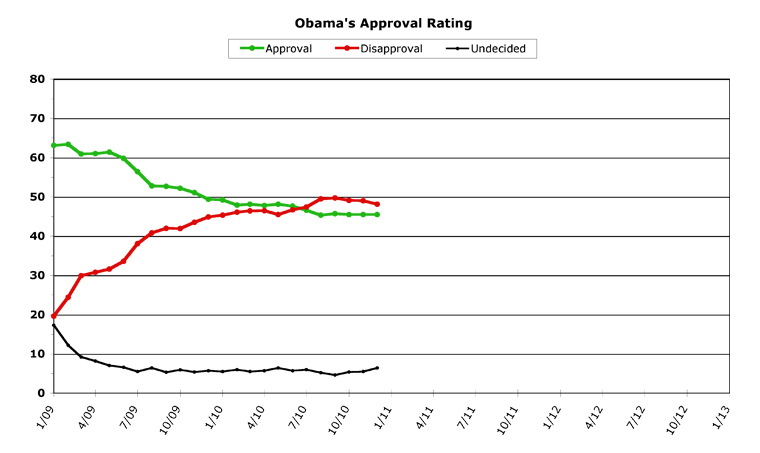
President Barack Obama had a mildly good month in the polls during December. Not a fantastic month, mind you; maybe not even a great month... but a mildly good month, nonetheless.
Continuing last month's trend (if you can even properly call it a "trend," that is...), Obama once again charted an unbelievably stable month in terms of approval ratings. The mildly good news was in his disapproval rating, which dropped significantly over the course of December. In fact, Obama had the second-best month he's ever had, in terms of a dropping disapproval rate. The note of caution, though -- which makes this only mildly good news for him -- is that all of the drop in disapproval went to the "undecided" category, and none of it translated into a bump in approval.
Let's take a look at Obama's actual chart, to see what I'm talking about:
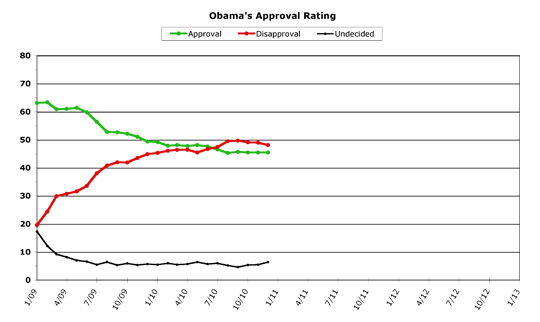
[Click on graph to see larger-scale version.]
Continue Reading »