ChrisWeigant.com

Friday Talking Points [154] -- Egypt Rising

[ Posted Friday, February 11th, 2011 – 17:37 UTC ]

The stunning news today of Egyptian leader Hosni Mubarak stepping down has all but eclipsed the other political news of the week. Who would have thought, a month ago, that a government that had oppressed its own people for over three decades would fall simply because a bunch of people marched in the streets and refused to give up?

American politicians are still trying to figure out how they should react. Although shocking to some, this is entirely normal. The people of Egypt have spoken, and before it happened, nobody could have foreseen how fast or how effective it was going to be. The demonstrations surprised the Egyptian government as well as the American government. The main lesson to be learned here is that sometimes, in our new cyberspace world, events move faster than analysis can hope to. That's one of the strengths of such "people power" movements -- their inherent unpredictability.

Of course, democracy is unpredictable as well. If Mubarak's exit truly does usher in an era of true democracy in Egypt, then the fact of the matter is that nobody knows what it will mean for the future. Nobody can predict who will win a free and fair election, what the Egyptian government will look like after one, or what it will mean for the region, the United States, Israel, or the rest of the world. But that is the nature of democracy.

Continue Reading »

21st Century Lightspeed Scandal

[ Posted Thursday, February 10th, 2011 – 16:52 UTC ]

Hoo boy.

What fun is a scandal if you don't even have time to make fun of it?

No, wait, let me start over....

Representative Chris Lee just set the Washington speed record for scandals, clocking in just under an astonishing three-and-a-half hours, from start to finish. This stunning display of the warp-speed nature of living in the 21st century will likely become the gold standard speed record of Washington scandals for some time to come. Or maybe not... maybe we'll enter into a cycle of ever-quicker scandals erupting and concluding with blinding speed.

The Chris Lee scandal unfolded fast. Really fast. It unfolded so fast, comedians didn't even have time to write jokes about it. It happened so fast, liberals didn't even get a single gleeful day of poking fun at the New York Republican. It happened so fast that nobody even had time to turn it into a "-gate" word! That's really fast indeed. The closest I've come across is the "Craigslist Congressman," which is amusing but not really on a world-class level, when it comes to slapping a cute label on a scandal.

Continue Reading »

Can Boehner Count Votes?

[ Posted Wednesday, February 9th, 2011 – 17:07 UTC ]

Speaker of the House John Boehner seems not to be able to count votes very well. Or, to be more charitable, perhaps he's just working through his opening day jitters. But it certainly seems that he is indeed making a few rookie vote-counting mistakes as he learns his new job.

Consider his handling of a bill to renew three provisions of the Uniting and Strengthening America by Providing Appropriate Tools Required to Intercept and Obstruct Terrorism Act of 2001, more commonly known as "the Patriot Act." Three parts of this law are going to expire if Congress doesn't renew them by February 28. A bill to do just that was introduced in the House, under "fast track" rules which are normally used for bills which aren't all that contentious. The reason why contentious bills aren't usually fast-tracked is that they require a two-thirds majority vote to pass -- a mighty high bar indeed. Boehner, apparently assuming he had the votes, brought the Patriot Act renewal up under the fast-track rules -- which then failed to gain the required majority by seven votes. The Washington Post called this an "embarassing setback" for House Republicans.

Continue Reading »

Oh, Say, Can You Sing?

[ Posted Tuesday, February 8th, 2011 – 18:15 UTC ]

Christina Aguilera is -- quite rightly -- getting a lot of grief these days, because she flubbed a line while singing the National Anthem at the start of last weekend's Super Bowl. But while her mangled version of the lyrics was pretty cringe-inducing, to me what was completely indefensible was her mangling of the tune itself. Because this is one song which really shouldn't be open to "interpretation" -- at least not during such a prominent event.

The lyrics-scrambling was bad enough. Instead of singing:

Oh, say, can you see, by the dawn's early light,
What so proudly we hailed at the twilight's last gleaming?
Whose broad stripes and bright stars, thru the perilous fight,
O'er the ramparts we watched, were so gallantly streaming?

Aguilera sang:

Oh, say, can you see, by the dawn's early light,
What so proudly we hailed at the twilight's last gleaming?
Whose broad stripes and bright stars, thru the perilous fight,
What so proudly we watched at the twilight's last gleaming?

Whoops. That sound you just heard was Francis Scott Key, turning over in his grave. The question that immediately pops to mind is, of course: Has any bright editor out there already used the headline: "Star-Mangled Banner"? Inquiring minds want to know. Heh.

Continue Reading »

Obama: Too Many Boats Have Been Left Behind

[ Posted Monday, February 7th, 2011 – 16:31 UTC ]

Corporate America is on our minds today, because President Obama just gave a speech to the U.S. Chamber of Commerce. With the future decidedly uncertain, Obama made overtures to the corporate community, and also called on them to be responsible and help build the middle class of this country, by insuring that all boats are lifted by the tide, and not get (as he put it) "left behind, stuck in the mud." This wasn't the only time in the speech he got Kennedyesque, also calling on the corporate titans to: "Ask yourselves what you can do to hire more American workers, what you can do to support the American economy and invest in this nation."

President Obama also included a lot of warm outreach to the private industry, including the "winning the future" laundry list from his State Of The Union speech (education, innovation, investment). He reached a hand out on the subject of his health reform law, regulatory reform, and revamping the tax code. He also called on the business community to put the hundreds of billions in cash they've got sitting around to some good use in the future, instead of letting it sit in the bank.

Continue Reading »

Politics Ends At The Water's Edge

[ Posted Friday, February 4th, 2011 – 17:44 UTC ]

While there was indeed some domestic American political news happening last week, we're going to take a pass on focusing on any of it today. Instead, the news this week was dominated by foreign policy and events largely beyond America's borders. So, instead of dishing up our usual "Friday Talking Points" snarkiness here (did you hear Sarah Palin's trademarking her own name? Bristol, too!), and instead of providing useful soundbites for Democrats to use (unemployment dropped 0.8 points in two months!) and celebrating victories over Republican idiocy (such as shaming them out of changing the federal definition of rape to exclude non-incest statutory rape in an abortion amendment), we're going to do something different here today. We can wait until next week to begin highlighting Republican hypocrisy on budget-cutting, and all the rest of it. Because while Egypt's future is being worked out both in Cairo and in Washington, somehow it just doesn't seem appropriate to be handing out "most impressive" and "most disappointing" partisan awards this week. Instead of such pettiness, for the first time we're going to radically change our weekly approach here, and instead talk about bipartisanship of a very specific kind.

It can be summed up as: at times, politics is supposed to end "at the water's edge." This idea was originally put forth by Senator Arthur Vandenberg of Michigan at the dawn of the Cold War. What Vandenberg actually said:

Continue Reading »

He Is Us

[ Posted Thursday, February 3rd, 2011 – 18:49 UTC ]

Egypt, it seems, is failing to follow a convenient storyline for the American journalists to follow.

When the American television media woke up and realized something was going on in Egypt (approximately two or three days after it all started, and long after Al Jazeera was covering it wall-to-wall, it bears mentioning), their first thought was to be the first network to get an anchor to Cairo. Brian Williams apparently won this race, much to the consternation (one assumes) of his competitors.

This silly race happens whenever a truly big story breaks elsewhere in the world where Americans might actually care what is happening, and where four-star hotels exist. Note the qualifications -- stories which happen which are virtually the same as what is going on now in Egypt are routinely ignored by the big network anchors, when they happen in some godforsaken place that not one in a thousand Americans could locate on the world map. Even when such stories do happen, it seems the big anchors are only willing to cover it when there's a convenient posh hotel nearby in which to barricade themselves should the going get rough (and then, one assumes, complain about the slow response of room service).

Continue Reading »

Obama Poll Watch -- January, 2011

[ Posted Tuesday, February 1st, 2011 – 22:48 UTC ]

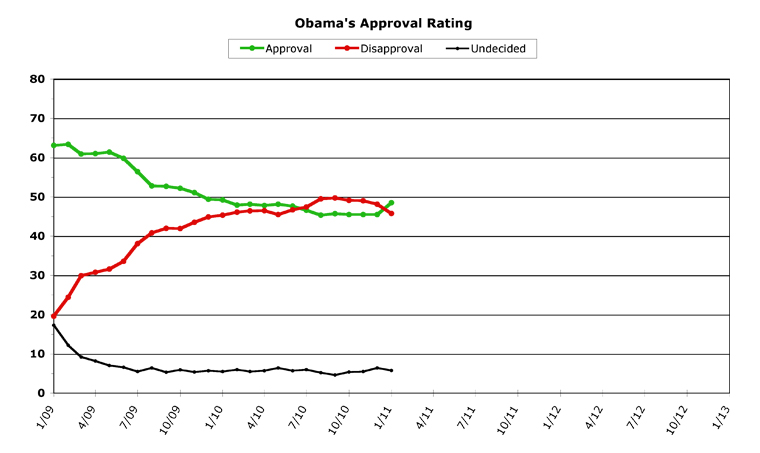
Obama's best month ever

Obama poll-watchers have been waiting to see a "bump" upward in public opinion job approval ratings pretty much ever since he took office. In two years, there really hasn't been one. Until now.

In January, President Obama's approval rating went significantly higher, while his disapproval rating continued a trend of dropping with a big spike downward. What both of these meant, taken together, is that Obama is once again "above water" in the polls, with his approval rating beating his disapproval rating. This hasn't happened since last June. But, in reality, Obama has pretty much erased his past entire year's slow slide in poll numbers -- in a single month. Obviously, he didn't hit an all-time high in absolute numbers, but still, when taken month-to-month, January, 2011 was Obama's best month of his entire presidency. Not only did he finally get his bump -- but it was a truly significant bump.

Let's take a look at the chart:

Obama Approval -- January 2011

[Click on graph to see larger-scale version.]

Continue Reading »

Tunisami!

[ Posted Tuesday, February 1st, 2011 – 17:35 UTC ]

Forgive me for being somewhat irreverent today (if not downright irrelevant), but I only have time for a quick note as I'm busy putting together tomorrow's "Obama Poll Watch" column (which is, I have to admit, a fun column to write and hopefully will be a fun one to read as well).

Two completely trivial things struck me while watching the ongoing "people power" movements in North Africa and the Middle East this week. The first was that it seems that more and more revolutions/people power movements today are color-coded. It makes perfect sense, from a sheer marketing perspective, and also from a crowd's perspective. If the movement chooses a color to rally around early on, then it's a lot easier to see who on the streets is on your side and who may not be. Militaries throughout history have used this principle in the color of their uniforms, for instance. But, increasingly, it seems that revolutionary movements also are self-identifying with a color (or, sometimes, colors).

The first modern people power movement using a color which I'm aware of (I'm not counting as far back as the "White Russians," I should mention) was in the Philippines in 1986, when the "Yellow Revolution" (or "People Power Revolution") brought Corazon Aquino to power. Crowds of people wearing yellow cheered this development, as I recall. Since then, we've had a Rose Revolution (Georgia, 2003-04), an Orange Revolution (Ukraine, 2004), a Pink Revolution (Kyrgyzstan, 2005), and a failed Green Revolution (Iran, 2009). Some also call voting in Iraq a "Purple Revolution" (due to the purple ink on the fingers in the voting process), but this label never really widely caught on.

And now we've got a Jasmine Revolution in Tunisia inspiring others in the region (in Egypt, Yemen, Algeria, Jordan, and likely elsewhere before it ends). Currently, the world is focused on Egypt, but as far as I can tell the people in the streets of Cairo haven't color-coded their revolution yet.

One wonders, in the future, what is going to happen when all the familiar colors have been used up by other countries. Will they begin a two-tone scheme (the Blue-Yellow Revolution), or go with ever-increasingly obscure colors (the Teal Revolution, the Fuchsia Revolution, the Ecru Revolution)?

Inane wonderings aside, though (hey, I already apologized for this column in advance...), I do have to point out one bit of brilliant wordplay and "branding," which apparently is now being used in Egypt -- but also which the American media hasn't really noticed yet. Because it covers not just each individual revolution/people power movement, but rather is a meta-term which describes the entire wave of movements sweeping the region: a "Tunisami."

This term has several things going for it, not least of which is the cutesiness factor. The whole thing started in Tunisia, after all. And the "wave/tsunami" imagery is pretty good and pretty accurate in terms of describing how things are spreading.

So, while I sincerely do hope to be forgiven for such trivialism in the midst of history being made, I would like to encourage everyone to start using this brilliant term to describe this historic era: the "Tunisami" of 2011.


-- Chris Weigant

Follow Chris on Twitter: @ChrisWeigant

 

Democracy's Drawback

[ Posted Monday, January 31st, 2011 – 16:15 UTC ]

America is a strong supporter of democracy worldwide. Except, of course, when we aren't. That piece of doublethink has been at the center of American foreign policy pretty much since World War II, and it is the heart of the conundrum we now find ourselves in regards to what is happening in Egypt and other countries in North Africa and the Middle East. Because we're conceptually all in favor of democracy -- right up until the "wrong" person or group wins an election. According to our definition of "wrong," of course. This is the key drawback to democracy (and American support of democracy in the rest of the world) -- sometimes the "wrong" people win.

At heart of this dichotomy is the realpolitik fact that America promotes its own ideals and values, while simultaneously looking out for its own national interests. When the two conflict, we almost always choose our national interests (as we see them at the time) over our lofty ideals. Sometimes this leads to disaster, sometimes it leads to stability, and sometimes it leads to an American president pulled in two different directions -- as President Obama is right now over the Egyptian protests.

Continue Reading »