[ Posted Wednesday, May 2nd, 2012 – 15:04 UTC ]
Hitting the ceiling?
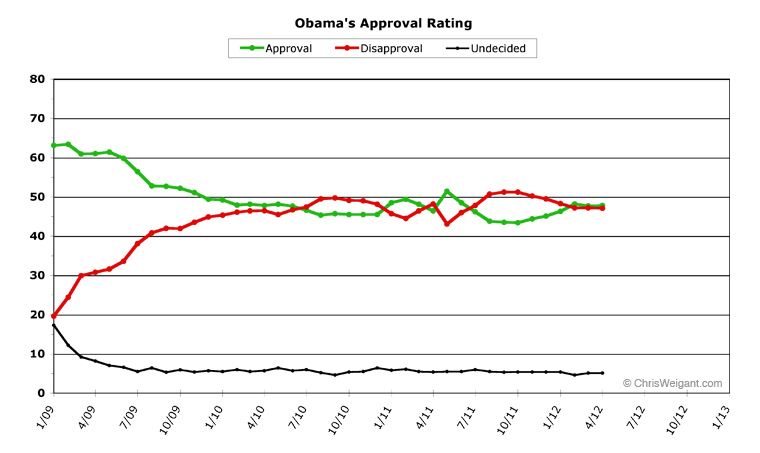
President Barack Obama had another uneventful month in the polls last month. I realize that's a pretty dull way to start a column, but we do the best with the data we are given, so to speak. Obama's average approval rate and disapproval rate both got better by the slimmest of margins -- one-tenth of a point -- which places him pretty much where he ended the past two months. His approval rating stayed above his disapproval rating, but by a margin of less than a full percentage point.
To liven up this morass of dullness, we are going to quickly run through the numbers here, and then we're going to take a look at what it all might mean in the upcoming election, by doing something we haven't done for a while -- comparing Obama to his predecessors' ratings.
First, let's take a look at the new chart for April:
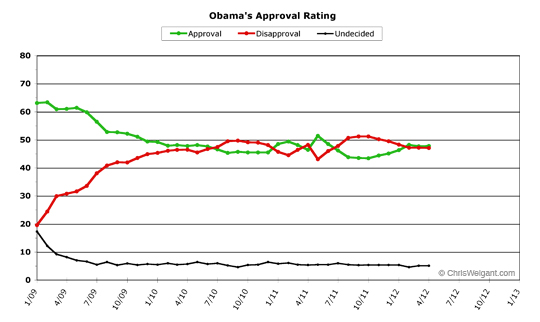
[Click on graph to see larger-scale version.]
April, 2012
Continue Reading »
[ Posted Tuesday, May 1st, 2012 – 20:05 UTC ]
There will be no column today, as I spent the time "occupying" the library, furthering my research. Tomorrow is "Obama Poll Watch" day, though, so that should make up for it. Also, preparations have begun for the general election season's "Electoral Math" column series as well, so you've got that to look forward too, as well.
-- Chris Weigant
Follow Chris on Twitter: @ChrisWeigant
[ Posted Monday, April 30th, 2012 – 16:22 UTC ]
Jimmy Kimmel is right... sort of. In this past weekend's schmooze-fest between media organizations and the president (and, for some inexplicable reason, Hollywood), Kimmel performed a comedy routine for the president and the assembled crowd. Towards the end (around 19:40 on the video), Kimmel made a few marijuana jokes. He started by directly asking the president "What is with the marijuana crackdown?" Of course, being a comedian, a few punchlines followed. But the most notable one -- like all good comedic roasting -- had a kernel of truth in it: "You know, pot smokers vote too. Sometimes a week after the election, but they vote."
Continue Reading »
[ Posted Friday, April 27th, 2012 – 16:11 UTC ]
We begin by saying we certainly hope we can live up to such an exuberant headline. You will have to judge for yourself whether all those exclamation points were justified or not.
The real reason for such titular excitement is the convergence of two contests here at Friday Talking Points headquarters. See? I had to restrain myself from typing yet another exclamation point, there.
One contest is over, and we are able to (finally!) crown a winner. And one contest is just beginning, so haul out your crystal ball and peer into the future with us, in the comments.
Last December, we ran a column entitled "Call The Newtsplosion Contest." In it, we used explosive terminology (such as "Newtroglycerine" -- although we have to admit that "Newtonium" and "Newtron Bomb" didn't occur to us until later...) to describe what was likely going to end Newt Gingrich's presidential campaign.
Continue Reading »
[ Posted Thursday, April 26th, 2012 – 16:52 UTC ]
We're going to, as Dave Barry likes to say, play "Mister Language Person" today. Mostly because it is so much fun. But we do realize that this is not everyone's cup of tea, so we are being extra polite and warning everyone, up front. Those of you scratching your heads over how an editorial (seemingly-plural) "we" can be said to be a (singular) "Mister," please continue reading (although we're not going to unravel that mystery today, sorry).
We speak today, instead, on the subject of verbizing. Verbizing, for those who have never heard the term, is the process of turning innocent nouns into verbs. This verbizing interlude is brought to you today by the trademark: "Etch A Sketch."
While Mitt Romney will be haunted by this term for the next few months, we're already seeing signs of the next step: verbizing. We even contributed to this trend ourselves yesterday with a parenthetical "Etch A Sketched?" comment.
Continue Reading »
[ Posted Wednesday, April 25th, 2012 – 15:23 UTC ]
Mitt Romney is now embracing his inner Etch A Sketch, it seems. With the news that even Newt Gingrich has finally decided that the race is over, Mitt now has no real obstacle along his way to securing his party's nomination for president, or to cement his support among Republicans. No real obstacle except himself, of course.
Conventional political wisdom in America dictates that any candidate "tack" to the extreme wing of his party in order to win the primaries, and then "pivot" back to the center in an effort not to seem too extreme to the independent voters which will wind up deciding the race in November. So, Etch A Sketch jokes aside, this was entirely predictable.
But the first issue Romney chose to show a glimmer of independence from Republican orthodoxy is an interesting one, because the deadline for action is right around the corner. Which means it will serve as a very important test for Romney's candidacy as a whole: can Mitt lead his own party -- especially in a direction in which they are not that interested in going?
Continue Reading »
[ Posted Tuesday, April 24th, 2012 – 16:36 UTC ]
Yesterday, I wrote a column which pointed out that negative campaigning in American politics can be traced back (at the very least) to Andrew Jackson's era. Today's column should be seen as nothing more than a footnote to yesterday's, which was inspired by one of the comments I got on my site yesterday in response. To put it another way, we're going to dive deep into history today, to the election of 1828, so if that sort of thing doesn't interest you, then I'd advise you to spend your time more profitably elsewhere.
Andrew Jackson's first successful run for the presidency has long fascinated historians, because it truly was the beginning of modern party politics in America. All the trappings of campaigns which seem so familiar today (things like campaign buttons or T-shirts or yard signs) all had their roots in the 1820s. Partly, this was due to a historical coincidence (a visit to America by the Revolutionary War hero Lafayette, which had started the craze of personalized scarves and other doodads as souvenirs), and partly it was due to the impressive political machine put together by pro-Jackson newspaper editors and the "Little Magician" (as he was known), Martin Van Buren. Van Buren, if alive today, would doubtlessly be swapping campaign stories on cable television with the likes of Karl Rove and James Carville, who essentially do the same job Van Buren invented during the Jackson campaign. All of which is fascinating, no doubt, but is beside the point I'm trying to make.
Andrew Jackson was ruthlessly and viciously attacked in the opposition newspapers of the day. He was called all sorts of names, and all sorts of evils were laid at his door by editors who most definitely did not want to see him elected.
Jackson, on the other hand, ran as a "man of the people" -- the first to ever do so in American presidential history. He was the original "born in a log cabin" president (a claim made repeatedly thereafter by many contenders for the White House).
Continue Reading »
[ Posted Monday, April 23rd, 2012 – 16:08 UTC ]
There's an element to American political campaigns which everyone hates and almost everyone loves to denounce: the negative campaign advertisement. From now until November, many will fulminate against the "coarsening" of our political culture these ads supposedly usher in, and many will call for Mitt Romney and Barack Obama (and all the candidates further down the ballot) to renounce negative campaign advertising -- to absolutely no avail. The mudslinging will continue apace right up until Election Day, for one very simple reason: such ads work. They are effective. Which means -- especially for those living in "battleground" states -- that the only way to avoid the onslaught of political negativity will be to stop watching television altogether, until the election is safely over.
Negative campaigning has been around much longer than even the medium of television, it bears mentioning. Slinging mud at political opponents stretches back to (at the very least) Andrew Jackson's time. It is not, as many myopic political pundits (or even "journalists") would have you believe, some sort of modern invention. Political ads nowadays aren't even particularly more personal or more brutal than what took place back in the 1820s, for that matter. Most of them are quite a bit tamer, in fact.
During his first successful campaign for president, Andrew Jackson's wife was accused of bigamy for marrying him. Jackson himself was painted as a bloodthirsty "military chieftain" who was known for murdering his subordinates, and (in his spare time) fighting "pistols at dawn" duels with private citizens. The Jackson folks countered (falsely) with a story of how John Quincy Adams had "pimped" out "an American virgin" to the Czar, while Adams was America's ambassador to Russia. Can anything said so far (or likely to be said before November) in the current election compare, on the "coarsening of American politics" scale? And this is but one brief example from the history of presidential campaigning -- you really don't have to look very far to find others which are equally as bad. Scathing and scurrilous campaign mud has been routinely slung for roughly two centuries in America, whether anyone in today's media remembers these facts or not.
Continue Reading »
[ Posted Friday, April 20th, 2012 – 16:35 UTC ]
Today is a day two incredibly different groups celebrate. Marijuana enthusiasts, who nationwide adopted a bit of 1970s high school slang from Northern California, are holding various events around the country today, because it is "4/20." Not as well-publicized (by design, for the most part), white supremacists and other hate groups celebrate today as the birthday of Adolph Hitler. The two celebrations and the two groups have nothing in common, I should point out. I'd even bet the overlap between the two groups is almost non-existent.
April 20th is also the day the Columbine shooting happened in Colorado in 1999, but the two shooters may not have picked this day for anything to do with Hitler, they may have been one day late in their plans (April 19th is the anniversary of the fiery end to the Waco siege in 1993, and also of the Oklahoma City bombing in 1995). April 20th is also, by coincidence, the same day BP's Deepwater Horizon oil well blew up in the Gulf of Mexico.
What does it all mean in the grand scheme of things? Not a lot, unless you happen to be an astrologist or a numerologist. Or a university administrator trying to stop all the students from blatantly "sparking up" in public, I suppose. Why, you may wonder, am I even bringing up Hitler and explosions and other things that are, like, totally bumming everyone out? Well, because (sadly enough) Hitler's in the news.
The Republicans seem to have chosen Double Down On The Crazy™ as their new campaign motto for 2012. One Senate candidate, in West Virginia, says new anti-smoking regulations are pretty much the same thing as that time when Hitler made all the Jews in Germany wear yellow Stars of David. Unfortunately, I am not making this up.
Continue Reading »
[ Posted Thursday, April 19th, 2012 – 16:36 UTC ]
[Program Note: There's really not much to say about the Secret Service's prostitution scandal that hasn't already been said. In fact, I've already weighed in on the bigger picture myself, four years ago, when Eliot Spitzer made the news as "Client Number Nine." So I thought it'd be a good day to dig this out of the archives and run it again. It was originally written with politicians in mind, but expanding the project to cover the Secret Service really wouldn't be all that big a stretch....]
Continue Reading »