[ Posted Wednesday, January 9th, 2013 – 18:28 UTC ]
Last night, on a primetime television show, a character had an abortion. Does this shock you? It might, if only for the fact that such a plotline is so incredibly rare on American television. In less than two weeks, the Supreme Court decision in the landmark Roe v. Wade case will be forty years old. Four decades later, the debate over abortion still rages. But it is a debate which is largely silent on the small screen. Even last night, abortion did not really dare to speak its name.
The show I refer to is the NBC series Parenthood. Like many shows, when it first started, it was fairly brilliant and fresh and well-written, but it has faded a bit over time. The first year was edgy and realistic, with characters caught up in all sorts of life's problems -- but with (as the title suggests) strong family ties to fall back on in times of trouble. From this launching point, it has deteriorated to the point where either every plotline is resolved with rainbows and sweetness, or blows up in spectacular fashion (only to be resolved later, with unicorns and fields of flowers).
I say this not as a television critic (which I fully admit I am not) but to set the stage to discuss last night's show for those who have never seen an episode. Parenthood started out breaking some ground on television with (for example) a child with Asperger's Syndrome as a major character. In one of their first episodes, responsible adults (parents, even!) smoked some marijuana, and (gasp!) the entire world did not come to an end -- instead, they just got high for a while, and life went on afterwards. Recently, however, the plotlines have mostly devolved into "what can we think up next" sorts of episodes, and the main characters seem to have won several lotteries (must have missed that episode...) because no main characters ever have any money issues at all anymore. Even having said all of that, their decision to take on the subject of abortion was a brave one indeed, simply for the fact that so few other primetime broadcast television shows have ever done so.
Continue Reading »
[ Posted Tuesday, January 8th, 2013 – 18:53 UTC ]
President Barack Obama has it within his power to chart a new course for his administration on the Justice Department's continuing refusal to take into account the will of the voters in over one-third of the United States on medical marijuana. He could do so quite easily, by issuing a presidential pardon for Aaron Sandusky, who just received a 10-year prison sentence for running medical marijuana dispensaries in the state of California -- where such activities were legalized by the state's voters.
Sandusky, upon hearing his sentence, had this to say to the court:
I want to apologize to those with me and their families who have been victimized by the federal government who has not recognized the voters of this state. I want to apologize to the families who are suffering and who have to go through this. There are no winners here. Not the state, not the federal government, not the patients who need medical marijuana.
Continue Reading »
[ Posted Monday, January 7th, 2013 – 16:13 UTC ]
What with all the fiscal cliffery in the past few weeks, a few important news stories got short shrift from the chattering classes ensconced within the Beltway. With the pundits all now apparently ready and willing to chase the next shiny, shiny object in the budgetary battles (debt ceiling! platinum coins!) or perhaps to obsess over Chuck Hagel's nomination to Secretary of Defense, the story of Republican governors across the land ushering in a new era of federal control over health insurance was barely noted. This is a shame, because the irony of their stance is so downright amusing.
The Patient Protection and Affordable Care Act (otherwise known as "Obamacare") put Republican governors between an ideological rock and a very hard place for conservatives. After losing their court challenge on the constitutionality of Obamacare, each state's governor was faced with a clear choice: either set up a state-run health insurance marketplace (or "exchange"), or refuse to do so and pass the buck to the federal government, which will set up an exchange for states who opt not to create one on their own.
Continue Reading »
[ Posted Friday, January 4th, 2013 – 17:32 UTC ]
So, did we all have fun over the holidays?
The fiscal cliff fight went right up to the last minute, then we all momentarily Thelma-and-Louised over the cliff, and then Congress actually voted on a federal holiday. This last bit was so stunning, Congress is now going to take a two-week vacation just to recover (you know, from actually having to do their jobs). We missed commenting on most of this because we were busy doing our two-part year-end awards show (while also taking time to note that your constitutional right to flip the bird to a police officer has just been reaffirmed).
If we had a "best quote" awards category, we'd certainly have to nominate what outgoing House Republican Steven La Tourette had to say about the whole situation, after the Senate had voted 89-8 to approve the fiscal cliff avoidance deal: "We should not take a package put together by a bunch of sleep-deprived octogenarians on New Year's Eve." Now that's funny!
Humor aside, though the deal went through and immediately a contest erupted between Left and Right to see who could denounce the deal in highest dudgeon possible. We are not going to join in this flagellatory orgy, however, and are going to use our Friday Talking Points this week to point out why this deal is not just a pretty darn good one, but actually downright historic.
For those who may not agree with the previous statement, here's something we can all agree upon, in the spirit of entering the new year cheerfully -- Congress is now one-hundred-percent Lieberman-free! Woo hoo! Not so sorry to see you go, Joe. Now please get off my teevee screen on Sunday mornings, OK?
Continue Reading »
[ Posted Thursday, January 3rd, 2013 – 17:59 UTC ]
A federal appeals court has reaffirmed every American's right to communicate with the police solely through the use of the middle finger. You read that correctly: what is variously called "flipping off" or "flipping the bird" or "the one-finger salute" -- even to a police officer -- is indeed protected speech under the United States Constitution. Which is a victory for free speech and the First Amendment.
Now, I'm not coming out in support of flipping cops off on a regular basis or anything, just to be clear. Most cops are hard-working folks and do their jobs bravely and with distinction. Getting flipped off doesn't make their jobs any easier, no matter who is doing so. But while I'm not prone to using this method to communicate with police officers, I have to say that it's nice to know that should I ever find myself in a situation where I did find it appropriate, I would not be arrested merely for doing so. Because, after all, this is America.
Continue Reading »
[ Posted Wednesday, January 2nd, 2013 – 17:17 UTC ]
Obama's Second Honeymoon
President Barack Obama is currently enjoying not only a vacation with his family in Hawai'i, but also a "second honeymoon" with the public at large. In fact, his job approval numbers are looking healthier right now than they have since the end of his first "honeymoon" period in 2009.
We'll get to all of that in a moment, but first just a reminder that next month will usher in some changes here at ObamaPollWatch.com. We're not exactly sure what's going to change or how it's going to change, but we are diligently exploring how we can improve and update the design of our charts, to begin Obama's second term. Should we only compare Obama to other second-term presidents and just end the charts for all the one-timers? Should we show Obama's numbers on one extended chart, or have separate charts for each term? Should we reset the "highest" and "lowest" numbers for the second term as well? These questions and others are being pondered, so feel free to weigh in with any technical suggestions, in your comments.
OK, enough of that, let's get right to the charts:
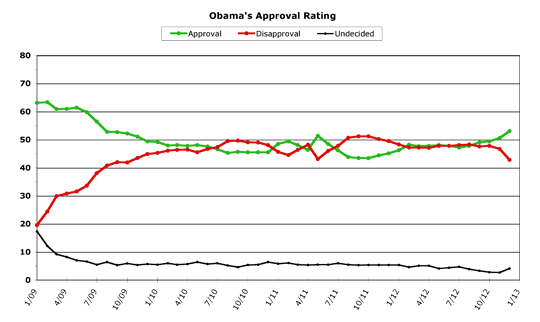
[Click on graph to see larger-scale version.]
December, 2012
Continue Reading »
[ Posted Monday, December 31st, 2012 – 18:10 UTC ]
Yes, it's that time of year again, folks! Time to cleanse out our vocabulary's lower intestinal tract with a purge of all the now-clichéd triteness we've been using with abandon all year long.
As always, we bow to the wisdom emanating forth from the noble groves of Academe which are located on the frigid shores of Gitche Gumee. I speak, of course, of the Lake Superior State University, who has been tirelessly fighting this losing battle for decades now.
Continue Reading »
[ Posted Friday, December 28th, 2012 – 18:02 UTC ]
Welcome back to our annual year-end awards column!
In case you missed it, Part 1 of our "McLaughlin Awards" (named for the television show where we get these categories, of course) ran last week, so check it out.

Destined For Political Stardom
Last year, I chose Elizabeth Warren for this award, so I'm feeling pretty good about my prognostication in this regard.
There are some obvious choices in the Destined For Political Stardom category. On the one side, Marco Rubio and Paul Ryan (although an argument could be made they're already political stars in the Republican universe). Chris Christie is going to run for president in 2016, making him an obvious choice as well. On the other side of the aisle, there are the Castro twins from Texas, Julian who is the mayor of San Antonio, and his brother Joaquin who is in the House of Representatives. Julian's keynote speech at the Democratic National Convention was one of those career-launching moments, indeed.
Continue Reading »
[ Posted Thursday, December 27th, 2012 – 16:22 UTC ]
The mainstream media is letting American taxpayers down, once again. Because there's a change coming in everyone's first paycheck of the new year that most of the news stories about the fiscal cliff negotiations only occasionally mention, and usually just in passing. But the impact will be widely (almost "universally," in fact) felt, and it's going to mean a pay reduction for all workers of two percent. Taxes are going up by this two percent, meaning paychecks will be smaller. And -- here's the important part that gets lost in all the breathlessness over the fiscal cliff by blow-dried newsfolks -- this change is going to happen no matter what gets agreed upon to deal with the rest of the fiscal cliff.
You would think that the news that everyone's paychecks are going to get smaller would be well-covered, but you would be wrong. So far, the stories have focused more on one single aspect of all the deadlines tied into the fiscal cliff -- the Bush income tax rates. These are the tax rates you'll find in the "tax schedules" you'll use to fill out your income tax form, and are the ones deducted from your paycheck as "federal taxes." Since the rest of the media universe is obsessed with this factor, we're going to ignore it here, for now. Whatever happens, happens. So be it.
Continue Reading »
[ Posted Monday, December 24th, 2012 – 18:14 UTC ]
[Program Note: This column originally appeared on December 23, 2009. While it may be the polar opposite of my normal writings, I felt today was the appropriate day to warn everyone of this global conspiracy, once again.]
Speaking as someone who generally enjoys a good conspiracy theory just for the "creative writing" aspect alone, in all good conscience I simply must report this shocking news: I have uncovered a big, fat conspiracy that is no mere theory. We're either being lied to, or we're joining in the propagation of the lie ourselves, with merriment. In actual fact, it would not be hyperbole to call this the father of all conspiracies.
And almost every single one of us has participated in this gigantic hoax, in one form or another, at least once in our lives. For many, it happens like clockwork on a regular basis. And it seems to prove Hitler's point about the "Big Lie" -- if you repeat it often enough, sooner or later a certain segment of the populace will accept it as being true.
This vast conspiracy is not limited to even America, although it certainly has a red, white, and true-blue-American following. While not exactly world-wide, the conspiracy reaches about as far as any such enormous falsehood has ever reached on our globe, so that even peoples who don't buy into the conspiracy's underlying storyline still participate in the conspiracy with jolly abandon.
Continue Reading »