[ Posted Wednesday, May 11th, 2011 – 17:50 UTC ]
This has been an unusual year, in terms of presidential campaign politics, because (so far) it has run counter to the conventional wisdom. A standard column for any pundit to write every four years is the "Campaign Starting Even Sooner!" article, in which you decry the fact that the presidential race is beginning earlier and earlier each cycle. Not many of those articles have been written this time around.
Consider that, four years ago, every single Democrat and every single Republican candidate were already in the race by February. A total of 19 serious candidates (both parties combined -- both parties had "open" races, I should point out) were already out on the hustings by March, 2007. The last time around, Republican candidates had raised around $50 million by this point.
This time, the story so far has been the lack of such a story. But all such good times must eventually come to an end, and I now find myself sitting down for the first time to assess the Republican field of candidates for 2012. It has become impossible to ignore any further, in other words. The first Republican televised debate happened last week, and today none other than Newt Gingrich officially jumped into the running.
But, because this is a first look at the race, I feel it is necessary to examine the entire field of candidates -- which is enormous, when everyone whose name has ever been mentioned as a possibility is added in. Even weeding out the obvious vanity candidates with no hope leaves over a dozen names, at this point -- and that's not even counting a few names some Republicans are all but begging to get into the race.
Because I'm trying to include simply everybody, this will necessarily have to be a very wide (and not very deep) look at all the possible candidates. It's going to be a lengthy article, folks, just to warn everyone up front. As the race heats up, I promise we'll get more detailed and more focused on the true possibilities. I've divided the candidates up into several categories, on mostly arbitrary criteria (in other words, some of these names could easily move around among the categories as time goes on).
Continue Reading »
[ Posted Tuesday, May 10th, 2011 – 16:31 UTC ]
Every so often, a press release catches my eye in such a fashion that I think to myself: "Aha! This means I don't have to write an article today!" Ahem. Today is one of those days.
The Library of Congress today announced the launch of what they're calling a "National Jukebox" which puts the entire pre-1925 Sony catalogue of recordings online to the public for free. This is the coolest use of tax dollars I've seen in quite a while, so I thought I would give it the exposure it deserves.
In the ongoing debate (which has been raging for over 200 years now) as to the size of government in America, this is the type of thing which should be an exemplary example of government at its finest. These recordings are no longer commercially viable, and Sony would never make any money releasing them. So why not give them to the Library of Congress so that they can be enjoyed by a much wider audience online? These have moved from the commercial world into the realm of being historical documents, and that's exactly what the Library of Congress should be about -- preserving such history for future generations.
Continue Reading »
[ Posted Monday, May 9th, 2011 – 17:12 UTC ]
In roughly two months, President Barack Obama is going to announce the beginning of the end of America's longest war. He could not have known, when he initially set this summer for the beginning of the withdrawal of American troops from Afghanistan, that the timing would work out so perfectly. With Osama Bin Laden now dead, it's going to be a lot easier to begin pulling out of Afghanistan. The only question left to ask is how fast this drawdown will be accomplished.
Afghanistan has been called "the graveyard of empires" due to the fact that nobody has ever been able to truly conquer it -- and mighty empires have exhausted themselves trying. The United States entered Afghanistan after 9/11 to get rid of the Taliban and the safe havens for Al Qaeda in the country. After the initial success, however, President George W. Bush soon became distracted with his misadventure in Iraq, and never devoted the military force Afghanistan required. If Osama Bin Laden had been killed in the mountains of Tora Bora, it is very likely all American troops would be out of the country by now, but this opportunity was missed. Throughout Bush's tenure, we never had more than 30,000-40,000 troops in Afghanistan. Obama tripled this number in two "surges" (the first of which the media barely noticed), and there are now approximately 100,000 troops in the country. When the second of these escalations was announced, Obama set a deadline of this summer to announce his withdrawal plans.
Now that Bin Laden is dead, Obama has a wider range of options to choose from, in terms of how fast he's going to get our troops home. Bin Laden's death meant (among other things) that Obama has the political leeway to withdraw troops much faster now. The American public is tired of this war (when they even notice we're still fighting it), and the politicians have slowly come to realize this fact. Both Democratic and Republican support for the war is fading in Congress, which (again) makes Obama's task that much easier.
Continue Reading »
[ Posted Friday, May 6th, 2011 – 16:01 UTC ]
Mission freakin' accomplished.
I don't care how ironic that sounds to some, it's true. Osama Bin Laden declared war on America, waged that war for years (and killed Americans in doing so), then hid for many more years, and was finally hunted down and killed like an animal. Mission accomplished.
I wouldn't care, at this point, if the White House dusted off the old Bush banner and hung it out on the front of the building. Because the mission of killing our number one enemy was successfully accomplished last week, which pushed almost all other news aside. Some days in the news business you find a "single-story day." This was a single-story week. It was that important.
Continue Reading »
[ Posted Thursday, May 5th, 2011 – 16:26 UTC ]
The Obama White House was decisive and bold in how they went after Osama Bin Laden last weekend. But in all the planning for this mission, it seems that nobody really planned ahead for success. Because, post-raid, the White House has had somewhat of a communication problem explaining everything to the public. This was avoidable, but is also mostly excusable due to the success of the mission (if you think the political arguments are rough now, just imagine what they would be like if we had failed somehow). Doing a practice run of the press management afterwards was probably pretty low on everyone's priority list last week, in other words, and most of the issues raised since then are already mere historical footnotes to the fact that we "got him."
But there's one issue which is indeed a valid one. The White House should never have let the military use the code name "Geronimo" for either the mission or Osama Bin Laden himself (depending on which media report you believe). Even if they had allow its use, they never should have publicly released the fact that the words transmitted to indicate success were "Geronimo E.K.I.A." (or, if used for the mission, perhaps "Geronimo, E.K.I.A.") The acronym stands for "enemy killed in action," and was the signal that Osama Bin Laden was dead.
Continue Reading »
[ Posted Wednesday, May 4th, 2011 – 15:29 UTC ]
Gas prices up, Obama polls down
This is going to be the shortest one of these columns I've ever done.
Every so often, I write a column and it is out of date very soon after it is published. On occasion, my columns are out of date as they are published, because I cannot read the news and write at the same time. But I don't think I've ever written a column before which was provably out of date before I even wrote it. That describes this month's Obama Poll Watch column, however, because the news of Obama's polling numbers in April is already secondhand news. So I wouldn't blame you a bit if you just skipped the whole column entirely, this month.
The death of Osama Bin Laden on the second day of this month has overshadowed Obama's poll numbers from last month already. Obama's poll numbers in May are going to be a lot more interesting (to put it mildly) than his poll numbers from April are going to be. I realize all of this, but I still (for completeness' sake) feel obligated to put out this monthly report of where Obama stood last month with the public.
As I said, this is going to be a very short column, far shorter than our usual in-depth look at what is going on in the polling world. Let's just start with our monthly chart:
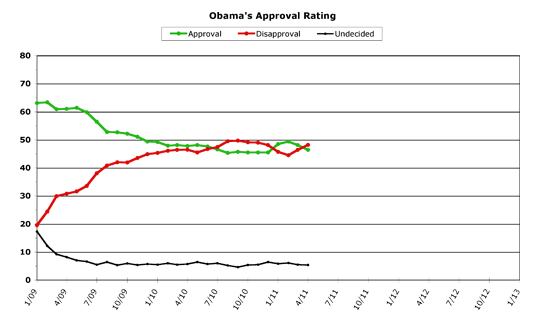
[Click on graph to see larger-scale version.]
Continue Reading »
[ Posted Tuesday, May 3rd, 2011 – 16:08 UTC ]
I don't write about sports very often. This column isn't even really about sports, either, it's about doing what is right. In baseball terms: "stepping up to the plate." The Los Angeles Dodgers baseball team needs to do so, because it is already overdue.
In case you haven't heard the story, San Francisco Giants fan Bryan Stowe traveled down to Los Angeles to catch the "opening day" game versus the Dodgers, a few weeks ago. These two clubs have an intense rivalry, I should add, although that really doesn't excuse any of this or even really make a difference. The Giants fan was brutally attacked in the parking lot after the game (assumably by a Dodgers fan). He was struck without warning, from behind, and then his head hit the pavement. He is likely never to fully recover the resulting brain injuries inflicted upon him, and was still in a coma the last time I heard news of him.
Continue Reading »
[ Posted Monday, May 2nd, 2011 – 17:00 UTC ]
To me, the most momentous phrase in the American lexicon is when a friend calls up and says some version of the following:
"Turn on your television... to any channel."
This is a scary phrase, for the most part, because of what it implies: some momentous event has not only happened, but all the television networks have switched over to live coverage of the news. You switch on your TV, and you don't even have to hunt for whatever's going on, because there it is on all of the possible serious channels. Last night, America had another of these moments.
What made it different than all the other such "any channel" moments in the past decade, though, was that the news was not bad. We did not hear about a natural disaster occurring, we did not hear about a space shuttle disintegrating, and we did not hear about a war starting. Instead, we heard about the death of America's number one sworn enemy, Osama Bin Laden. While realizing that "celebrating" anyone's death is not just a little bit unseemly, it was hard to see last night's news as anything but good for the United States of America.
Continue Reading »
[ Posted Friday, April 29th, 2011 – 15:58 UTC ]
This is going to be a somewhat surprising column introduction, for our regular readers. For new or occasional readers, I'd have to recommend just skipping this whole introduction entirely, and scrolling down to the awards section and the talking points for the semi-serious commentary. Because I'm about to talk about something I've been absolutely ridiculing all week long -- the royal wedding. And how the American media missed a joke (not to mention a kiss), despite spending millions of dollars in coverage in an orgy of "reporting on the shiny and the distracting, and calling it news." In other words, they couldn't even get it right at their absolute shallowest. Which is why I certainly won't be offended if you just skip this entire section. In other words, I can't believe I'm about to do this... but here goes.
For reasons which surpasseth all understanding (at least to myself), I was actually up very early this morning, before the dawn as a matter of fact. This was due to a scheduled television appearance which, unfortunately, did not occur (for technical reasons). Since I was up, though, I caught the tail end of the British royal wedding, which (for us Pacific Coast Time folks) happened in the middle of the night. Surprisingly enough, I have a few things to point out about the event.
Continue Reading »
[ Posted Thursday, April 28th, 2011 – 16:45 UTC ]
In all the foofaroo over President Obama holding himself above Hawai'ian law by actually obtaining his "original" birth certificate (my humble prediction: sooner or later, some Republican is going to excoriate Obama for "breaking Hawai'ian law" over this incident), nobody has taken the time to apologize to Hawai'i, which I think is a shame. Because some mighty vile insinuations have been leveled towards the state in the preceding few years, by conspiracy theorists wide and far.
But that's OK. Hawai'i can take a joke. Even the joke of birtherism -- Hawai'i takes it all in stride.
I offer up, as evidence of this fact, the "reporting" done in Hawai'i by Triumph The Insult Comic Dog.
Continue Reading »