[ Posted Wednesday, January 11th, 2012 – 18:09 UTC ]
Two hundred and thirty-six years ago this week, a pamphlet was published in Philadelphia. There is some disagreement among historians over the exact date (variously given as January 9th or 10th), and the pamphlet's title page itself only lists the year, 1776. Whatever the actual date, though, Thomas Paine's Common Sense hit the American consciousness like a bombshell -- one which would reverberate for years to come.
The full title of the work is: COMMON SENSE, Addressed to the Inhabitants of America, On the following Interesting Subjects. I. Of the Origin and Design of Government in general, with concise Remarks on the English Constitution. II. Of Monarchy and Hereditary Succession. III. Thoughts on the present State of American Affairs. IV. Of the present Ability of America, with some miscellaneous Reflections. After all, if you've got a whole page to use for a title, why not fill it up?
To summarize the pamphlet a bit more concisely, it was a call for America to declare her independence from Britain. As such, it was outright treason, of course -- which is why it was published anonymously at the time. It soon became the best-selling pamphlet ever printed in America -- and all over the world, after it was shipped and translated to other lands. Hundreds of thousands of copies were printed in America alone -- at a time when the entire population of the country was only a few million. To proportionally match this today, a book would have to sell something like 60 million copies in this country alone -- an almost-impossible feat.
Continue Reading »
[ Posted Tuesday, January 10th, 2012 – 18:55 UTC ]
Just a quick note, as we all watch the New Hampshire Republican primary results come in.
What struck me about New Hampshire's contest, being in the midst of historical research into such things, was the old-school nature of the Union Leader, a very conservative New Hampshire newspaper. It struck a lot of the media as interesting as well, but I didn't see anyone else commenting on such historical context.
Continue Reading »
[ Posted Monday, January 9th, 2012 – 16:11 UTC ]
Tomorrow, New Hampshire voters will go to their first-in-the-nation (don't-mention-Iowa-to-us-that's-a-caucus-dammit!) primary, and cast their votes in the Republican nominating contest. Which means it's time to haul out the old crystal ball and attempt to predict what's going to happen. If you hate these types of speculative wonktastic articles, then I strongly advise you to just close this article right now, and start a game of Angry Birds or something.
For the rest of you, I must first begin by reviewing how much my record stinks so far this year. As always, I believe political prognosticators are no different that the guys who predict sports in the media, and so I scrupulously report on my own stats as a predictor of political outcomes. And, as previously mentioned, I'm just not doing that good a job. In Iowa, I had the list as: Paul, Santorum, Romney (in that order). Eight votes separated me from total loss, and getting second right while switching first and third is really nothing to brag about anyway. Which brings our stats, so far, to:
Total correct 2012 primary picks so far: 1 for 3 -- 33%.
Nothing to write home about, as I said. But we're looking for our luck to change this week, because New Hampshire seems easier to call than Iowa turned out to be.
Continue Reading »
[ Posted Friday, January 6th, 2012 – 15:56 UTC ]
Welcome back, everyone, to our weekly political roundup! We've been away for three weeks, two of which were taken up by our annual year-end political awards columns, and last week was way too close to New Years' Eve to think straight (that's our excuse anyway), so we just tossed up a frivolous column to fill the space. But it's a new year, so it's time to reapply nose to grindstone and get down to brass tacks and all those other Puritan work-ethic metaphors.
I have to say, while the Republicans have been having their three-ring primary circus, President Obama has been looking better and better. Both in comparison to the Republican field (of nightmares, so to speak), and also because Obama's been making progress on his own.
The best news came today, as the official unemployment rate came down to 8.5 percent. This is one of those things that actually filters out of the wonktastic universe (in which we all live) to the American-at-large Joe-Sixpack public. I would be willing to bet that most readers of this column already knew that this Friday was Unemployment Number Release Day, right? Whereas the vast majority of Americans simply don't pay such close attention to politics -- but they will indeed hear that 8.5 percent number in the next few days.
It is, of course, too soon to tell, but this will likely help Obama's job approval polling numbers -- which are already on the rise. If the trend of improving employment continues, it could quite possibly yank the rug out from the entire campaign Republicans have teed up for this year -- so look for Republicans to try and convince America that things aren't really getting any better, over the next month or so. In other words, Republicans will be cheerleading for the immediate failure of the American economy, for base political reasons. So pop some popcorn, sit back, and enjoy!
Continue Reading »
[ Posted Thursday, January 5th, 2012 – 19:54 UTC ]
When we were all kids, "recess" was one of the happiest words in the English language, because it meant escaping the schoolroom for a while, and (on nice days) getting outside and running around and playing with our friends. The bell would ring, and we would all cry "Recess!" and run outside.
Would we have been just as happy if the word was not used, and we were still allowed to go outside and play? Yes, we would have. If the teacher stood up and announced in stentorian tones "We will all now adjourn to the playground" would we have been equally as joyful? Once again, yes.
Not to belittle the constitutional spat currently taking place in Washington, but I thought it best to put it into some sort of perspective. The reality of having fun on the swingsets and monkey bars far outweighed whatever it was called.
Continue Reading »
[ Posted Wednesday, January 4th, 2012 – 16:07 UTC ]
Trending Upwards
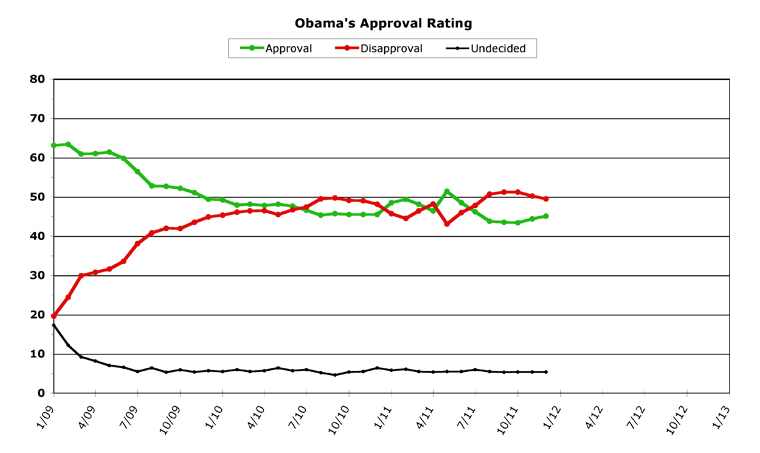
President Obama had a pretty good month last month in the job approval polls, bettering his standing in both approval and disapproval by roughly three-fourths of percentage point. This may not sound like that big a deal, but it was the second straight month of solid gains for the president in both categories.
Because it was also the last month of the year, we will take a closer look at how Obama did in 2011 at the end of the article. For now, let's take a look at the new overall chart for Obama:
[Click on graph to see larger-scale version.]
December, 2011
Continue Reading »
[ Posted Tuesday, January 3rd, 2012 – 21:48 UTC ]
I thought I'd wait to write today until the Iowa results were in, because I haven't done one of these "snap judgment" sorts of things for a while. As I begin, roughly 85 percent of the votes have been reported.
Mitt Romney seems to have squeaked out a victory over Rick Santorum, at least if the numbers hold (the two are separated by less than 1,000 votes). Ron Paul has posted a strong third place, with the rest of the pack clocking in at under 15 percent.
What it all means is tough to say at this point. New Hampshire is only a week away, and there will be yet another debate held over the weekend before that happens. Towards the end of the month, South Carolina and then Florida will vote.
The likely storyline to emerge in tomorrow's newspapers may well be the "inevitability" of Mitt Romney. These stories may wind up being correct. Romney seems poised to win a decisive victory in New Hampshire, but that has been expected all along, so it will not shake much of anything up. Winning Iowa, however, could be a much bigger deal for Mitt, because even Romney himself didn't believe he could win here until a few weeks ago. Iowa is a heavily conservative and evangelical state, when it comes to the Republican electorate. Rick Santorum's strong showing certainly proves that. But Mitt's victory shows he can win in such a state, which goes a long way in the "electability" category.
Continue Reading »
[ Posted Monday, January 2nd, 2012 – 16:20 UTC ]
I realize everyone is probably already sick of hearing predictions about the Iowa Republican caucuses, and if this does indeed describe you then you should probably go watch a football game or something -- because that's exactly what we're going to do today: throw prognosticatory Hawkeye darts at the wall, and take our chances as we may.
There's another sports reference worth mentioning, before we get started here. Sports guys love "stats." They love being able to quantify everything into discrete numbers so it's easy to see who is "best" and who is "worst" and everything in between. Even the sports pundits -- they'll make their predictions about which teams are going to win, and then tally up who got the most right. Personally, I think this is a practice which needs to carry over to the political chattering-class world as well. Pundits on television and in print should put their records up for public viewing, so that people can decide for themselves how much weight to give to future predictions by each of these political wonks.
So before we begin with the 2012 election cycle, here are my stats for the last time we danced this particular jig:
[Final 2008 Primary Pick Stats]
Total correct 2008 Democratic picks: 43 for 60 -- 72%
Total correct 2008 Republican picks: 37 for 50 -- 74%
Total overall correct picks: 80 for 110 -- 73%.
Continue Reading »
[ Posted Friday, December 30th, 2011 – 17:25 UTC ]
It's that time of year again -- when we turn our eyes to Lake Superior State University (in beautiful Sault Ste. Marie, Michigan), and their official list of this year's banished words.
It's really not all that amazing or ginormous, truth be told, but since both are on this year's list, we thought it only fitting to throw them into this article's title. The word "amazing" actually had what looks like an organized ballot-box-stuffing effort which successfully put it at the top of the list this year. Which is (sorry, I just have to...) truly amazing.
One other notable entry was "Winning The Future," which (as the folks at L.S.S.U. helpfully point out) has already been used by both Barack Obama and Newt Gingrich on the campaign trail. I think it was the only time last year I agreed with Sarah Palin, in fact, when she (also very helpfully) pointed out that "WTF" has another meaning in the initial-speak of today's plugged-in youth. Ahem.
But enough delay, let's get on with the list! You can view the whole thing (with commentary) at the official page for the "Lake Superior State University's 37th annual List of Words Banished from the Queen's English for Misuse, Overuse and General Uselessness" as it's worth reading in its entirety. This year's banished words and phrases:
Continue Reading »
[ Posted Wednesday, December 28th, 2011 – 17:41 UTC ]
[Program Note: Only a few days left in our Holiday Fundraising Drive! If you're sending your donation in by "snail mail," drop me an email and let me know the amount, and I will add it to our total. We're very close to reaching the goal we set, so get those last-minute donations in, folks!]
In lieu of a column today, we're going to throw the conversation open, with a question to get the ball rolling.
If Ron Paul wins the Iowa caucuses, what will the mainstream, inside-the-Beltway media do?
(A.) They'll suddenly discover Ron Paul, and give him the coverage and seriousness he deserves after winning the first Republican primary season contest.
(B.) They'll trot out the storylines they've been warming up all week to explain why "Ron Paul winning Iowa doesn't matter," and blame his win on (take your pick) the weather, the youth vote, the caucus system, the price of corn, or perhaps marijuana smokers.
(C.) They will totally and completely ignore Ron Paul and his victory, and go back to the Romney-versus-Gingrich storyline immediately.
-- Chris Weigant
Follow Chris on Twitter: @ChrisWeigant