[ Posted Monday, June 25th, 2012 – 17:11 UTC ]
It's time once again to begin seriously taking a look at the electoral math for the upcoming election. I know, I know, everyone else is court-watching this week, but instead I decided to spend some time poll-watching, for those of you who may be getting tired of endless Supreme Court speculation and analysis.
This column series will examine the race between Mitt Romney and President Barack Obama in the only way which is useful for actually predicting its outcome: a state-by-state look at how each candidate is doing. National polling is almost completely useless in election prognostication, because our Constitution simply does not care what the national vote totals turn out to be (see: the 2000 election). We actually elect presidents using the Electoral College, which makes such predictions a lot more complicated, since it necessitates examining each state's numbers individually. But complicated is our middle name here, so let's dig in and see what the state of the race (pun intended) truly is, at this point in time.
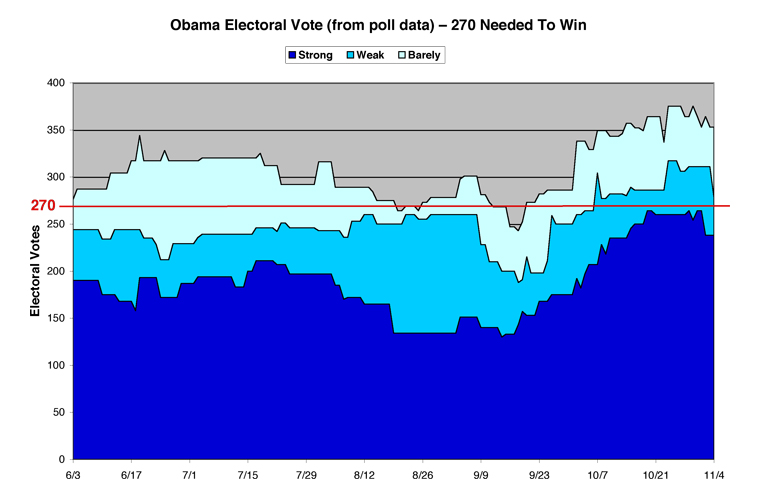
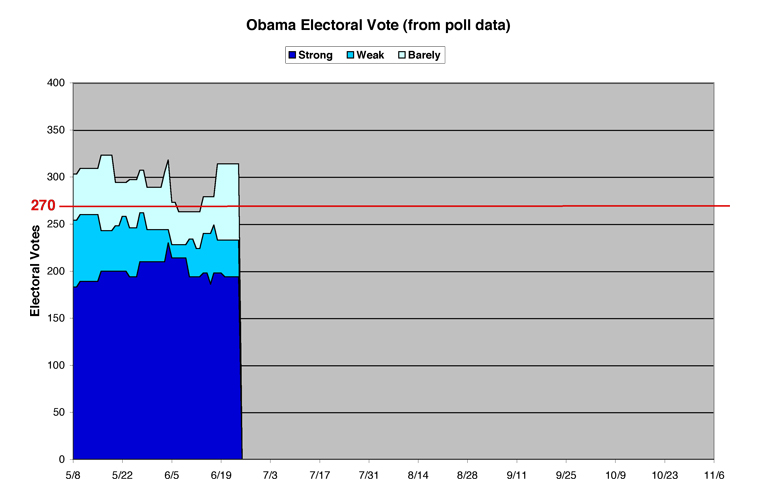
We're going to begin by taking a look backwards, in some ways. This column series ran throughout the 2008 election, which makes this fairly easy (since we saved the charts from back then). Let's start with a comparison of Barack Obama's status as it stands now, compared to what it was back in 2008. Future columns may refer back to the 2008 charts, but to begin 2012 with I thought a side-by-side comparison would be helpful (older charts are from my final 2008 Electoral Math column).
Final 2008 Obama Electoral Math Chart
2012 Obama Electoral Math Chart
A technical note before we begin -- we started our charts this year about a month earlier than we did in 2008 (May 8th versus June 3rd), so take that into account when comparing the two. Also, click on any of these charts to see a larger version, with all the details visible.
Continue Reading »
[ Posted Friday, June 22nd, 2012 – 17:44 UTC ]
For political wonks, this has been a week of waiting. Starting last weekend, we've all been waiting for Mitt Romney to address the issue of Barack Obama's new immigration policy. This waiting has been fruitless, and will continue for some time to come, apparently. Picture a phone ringing endlessly with nobody there to answer it... but we're getting ahead of ourselves.
The bigger waiting game this week has been at the Supreme Court, where two very important decisions are about to be handed down, on the Affordable Obamacare Act (so to speak), and on the Arizona immigration case. Both cases will impact the elections this year, but it is impossible to say how at this point. Either next Monday or next Thursday, however, we'll have at least a partial answer to this question.
Continue Reading »
[ Posted Thursday, June 21st, 2012 – 16:57 UTC ]
Maybe that should be "Navel-Gazing Column Ahead," you'll have to decide. You have been warned.
Well, we didn't notice until two weeks too late, but this column just celebrated its sixth anniversary. You read that right -- we've been doing this for six years (and two weeks) now.
The first of these columns appeared exclusively within The Huffington Post, but within a year I had managed to get the ChrisWeigant.com site up and running, and now we've got everything archived back to our very first installment (which, sadly enough, still has the ring of truth about it today).
I certainly had no idea, when writing that in June of 2006, that I'd still be here cranking these things out six years later. But here we are, against all odds.
Continue Reading »
[ Posted Wednesday, June 20th, 2012 – 17:21 UTC ]
My title today is a familiar phrase to anyone who went to school in America as a child. It seemed a relevant day to discuss the subject, since we're seeing some serious checking and balancing in Washington today. Since I don't have enough factual information on the situation surrounding Eric Holder and the "Fast and Furious" program to intelligently form an opinion at the moment, it might behoove us all to review the concepts involved with the separated powers of our government. If you would prefer instead to listen to uninformed partisan ranting, well, there's plenty of that out there today in the blogosphere, so feel free to read some of that sort of thing instead.
When the United States Constitution was being debated, strong arguments for it were made anonymously in the newspapers of the day, which were then consolidated into the Federalist Papers. In the ninth one of these essays, Alexander Hamilton wrote of "legislative balances and checks" in the new governmental structure. The concept (and the term "checks") was repeatedly discussed throughout the rest of the essays as well. At some point in time, the term must have been flipped around to the "checks and balances" we speak of today.
But while the phrase sounds noble, in reality what the different branches of our government regularly engage in is much more like a tug-of-war. This is what we're seeing today, between the Executive and Legislative branches. More on this in a moment.
Continue Reading »
[ Posted Tuesday, June 19th, 2012 – 16:38 UTC ]
Republican senators are backing up Mitt Romney's vacillation on the new changes in immigration President Obama announced last Friday -- with even more vacillation. To put it another way, Mitt Romney is effectively leading his party... into a morass of uncertainty.
The first inkling that President Obama's co-option of Marco Rubio's idea for a watered-down DREAM Act had created befuddlement in the Republican Party was, of course, Mitt Romney's waffling -- which we explored yesterday in great detail. Now the secondary ripples from Mitt's refusal to announce any sort of political stance or clear decision seem to be appearing.
Continue Reading »
[ Posted Monday, June 18th, 2012 – 17:17 UTC ]
Mitt Romney, candidate for president, seems not to be able to make up his mind. George W. Bush famously labeled himself the "Decider" when in office, but it seems Mitt is proving to be the "Can't Decider" this time around.
Romney has shown this trait on several issues in the campaign so far. Some important event or political policy problem gets into the news, the reporters covering his campaign flock to Mitt to find out his position, and it turns out to be: "we'll get back to you on that." Which never actually happens. Call Mitt a "Profile in Timidity" if you will.
To a certain extent, all politicians running for office try to play this game. Holding a strong position on any contentious issue will, after all, likely lose you the votes of those who don't agree with such a position. But Mitt seems to be taking this game to new levels. If they haven't already, the Obama team should really consider running one of those "it's 3:00 A.M." ads soon (to put it another way). Because there is being politically savvy, and then there is Mitt Romney's inability to take a stance on just about anything.
The case in point this week is, of course, immigration. Can any Romney supporter explain exactly what Mitt's position is on the Rubio/Obama "mini DREAM Act"? The man is all over the map on the issue, trying to have things about six ways at the same time. If the man actually had a position, it might be defensible from a certain point of view, but having no position (or every possible position) at the same time is simply indefensible, when you consider the job he's running for.
Continue Reading »
[ Posted Friday, June 15th, 2012 – 15:51 UTC ]
Marco Rubio's chances of becoming Mitt Romney's running mate just got a little worse. Granted, he is still a senator from Florida -- the biggest prize among the "battleground" states this November. But Rubio's signature issue was just completely and brilliantly co-opted by President Obama, which tends to significantly lessen Rubio's value to Romney as a vice presidential choice.
Obama today announced that a large chunk of the "DREAMers" would be allowed to stay in America, and even given work papers (or "green" cards, even though they haven't actually been green for years). The original Development, Relief, and Education for Alien Minors Act (or "DREAM Act") proposed by Democrats would have gone further than what Obama announced today, and given children brought to this country as minors who entered college or the military a "path to citizenship." Obama announced today that illegal immigrant young people will not be given a chance to walk this path quite yet, but will be able to legalize their status and live free of the fear of being deported to a country many of them do not even remember. Obama's action today is not a complete answer to the thorny problem of illegal immigration, but it is a step towards a comprehensive solution -- and a step in the right direction.
Continue Reading »
[ Posted Thursday, June 14th, 2012 – 16:48 UTC ]
President Obama gave a speech today in Ohio on the economy, contrasting his vision for the future with Mitt Romney's. The speech, on the whole, is a pretty good one -- it lays out exactly what the president believes and his political goals, and it also accurately portrays the beliefs and goals of his opponent. But what struck me was a repeated theme within the speech which Obama should start using more often.
Here is the first example, from a section where the president is describing the Republican economic plan:
Governor Romney and his allies in Congress believe deeply in the theory that we tried during the last decade -- the theory that the best way to grow the economy is from the top down. So they maintain that if we eliminate most regulations, if we cut taxes by trillions of dollars, if we strip down government to national security and a few other basic functions, then the power of businesses to create jobs and prosperity will be unleashed, and that will automatically benefit us all.
That's what they believe. This is their economic plan. It has been placed before Congress. Governor Romney has given speeches about it, and it's on his website. So if they win the election, their agenda will be simple and straightforward. They have spelled it out: They promise to roll back regulations on banks and polluters, on insurance companies and oil companies. They'll roll back regulations designed to protect consumers and workers. They promise to not only keep all of the Bush tax cuts in place, but add another $5 trillion in tax cuts on top of that.
Now, an independent study says that about 70 percent of this new, $5 trillion tax cut would go to folks making over $200,000 a year. And folks making over a million dollars a year would get an average tax cut of about 25 percent.
Now, this is not my opinion. This is not political spin. This is precisely what they have proposed.
Continue Reading »
[ Posted Wednesday, June 13th, 2012 – 15:41 UTC ]
Campaign 2012 is underway. Mitt Romney has won the right to challenge President Barack Obama for the Oval Office. The next four years of American politics hangs in the balance. One might think that, by now, we would be able to have some concrete idea of what either man would do for those four years. But sadly, this has not yet happened to any great extent.
Where are the grand messages of the campaigns? Being held in reserve for the post-convention season, perhaps? That's at least an understandable answer, but ultimately not a very satisfying one. Neither Obama nor Romney has yet clearly articulated what their big ideas are for the next four years, and both of them are missing the chance to pound their message into the American psyche for the next two or three months.
Continue Reading »
[ Posted Tuesday, June 12th, 2012 – 18:09 UTC ]
So, anything happen while I was away? Well, we'll get to all of that in due time, but today I'm going to indulge in some random reactions from the Netroots Nation conference instead. If this sort of thing does not interest you, then I guess you should check back tomorrow.
These are in no particular order, and are merely snippets of observation without deeper meaning, so please read them with that in mind.
First up, Providence, Rhode Island rocks. Great little city, and they did everything they could to roll out the red carpet for us. The mayor showed up and personally invited us to contact him if anything in our experience was lacking, which was a nice touch. Providence even held a "waterfire" for us, which was pretty special.
Continue Reading »