[ Posted Thursday, May 31st, 2012 – 16:48 UTC ]
Next Tuesday, Wisconsin voters will decide whether to recall their governor or not. Depending on who you ask, this will either be momentous or not matter much at all. Some who are now saying one thing will switch to saying the other, depending on how the vote count comes out Tuesday night. Polling either shows a tied race, or Governor Scott Walker with a slight edge -- depending on which polls you believe. Democrats have staged a late effort to rally the troops around their candidate, but even Bill Clinton's help may not be enough. Perhaps if the national party had paid attention to the race a little earlier, it might have borne more fruit.
It's hard to predict the outcome of the race, and it's equally hard to say "what it all means" in the grand scheme of things. The winning side will, no doubt, claim the victory as some sort of national mandate to push their agenda, but the outcome may be of limited importance no matter who prevails.
Continue Reading »
[ Posted Wednesday, May 30th, 2012 – 15:57 UTC ]
Maybe this election will be remembered as the "It's the jobs, stupid" election, who knows? It certainly is the central issue the public cares about, and it certainly seems to be the subject that the campaigns are fighting most viciously on the airwaves. This is probably as it should be, a presidential campaign waged on the "Number One" issue in the political realm. But Mitt Romney, it seems, wants to use one yardstick for his own jobs record and another for Barack Obama's. Stunningly, he is attempting to use both at the same time, hoping nobody will notice.
Thankfully, the "Plum Line" blog over at Washingtonpost.com did notice, and labeled the Romney arguments "surreal."
The Romney campaign reportedly just sent out some spin on Obama's jobs record as president versus his own jobs record as governor of Massachusetts. The talking point Democrats have been using (which his Republican opponents had previously been using) is that Massachusetts was "47th out of 50 states in job creation" during Romney's term -- and it is quite obviously getting under Mitt's skin. So he's conveniently rewriting his own record, to make it look better. This is what spin is for, of course, but Mitt has just opened the door for a realistic comparison of the numbers, even if the Romney team (or the Obama team, for that matter) hasn't realized it yet.
Continue Reading »
[ Posted Tuesday, May 29th, 2012 – 15:44 UTC ]
OK, we have three program notes today, one small bad one, one good one, and then another bad one.
First, the small bad one. There will be no column today.
The good news is that I have reached a milestone in the writing project I have been working on for the last ten months, which means I will now be paying more attention to this site -- answering comments, writing new articles on Tuesdays and Thursdays, etc. Because I spent my three-day weekend working hard to achieve this milestone, I am taking the day off today.
Continue Reading »
[ Posted Monday, May 28th, 2012 – 15:06 UTC ]
[Program Note: Hope everyone's enjoying their Memorial Day! This column ran two years ago, before the end of the "Don't Ask, Don't Tell" policy, but I thought it was worth running again today. Also, running it avoided having to write a new column. Anyway, enjoy, and hope everyone had a good holiday weekend.]
This column originally ran on May 31, 2010.
Memorial Day is the time to memorialize all the brave individuals who served our country throughout its history, and sometimes paid the ultimate price for doing so. But, in particular, this year I'd like to focus on all those who did their duty for their country, and fought for the American ideal of equality for all citizens -- even while they did not enjoy such rights themselves, either in the military or in American life at the time. These second-class citizens, one would think, would have even less reason than citizens accorded full rights under the law to risk death on a foreign battlefield, and therefore would not have volunteered to do so. One would be wrong in thinking this, however.
The best example of this is a study in extremes. The 442nd Infantry Regimental Combat Team (now known as the 442nd Infantry Regiment) was the most-decorated unit in all of World War II. You may not have heard of them, but their motto has entered such common usage that the phrase is now universally-understood: "go for broke." This was originally pidgin English used in Hawai'i to describe making a big bet, perhaps on the throw of the dice. The unit adopted it, and they were known as the "Go For Broke" Regiment, because many of the soldiers in the unit were from Hawai'i. Others were from the mainland. What made the unit different from others is that it was composed of Japanese-Americans.
Continue Reading »
[ Posted Friday, May 25th, 2012 – 17:12 UTC ]
We're going to open with what we'll call "Constitutional Tomfoolery, Part One" (you'll note that this implies, through a technique known as "foreshadowing," that the Republicans have exhibited some sheer silliness in reference to our country's founding governmental compact more than once in the past week). John Brunner, Republican candidate for the Senate from Missouri, made an extraordinary statement this week in a radio interview: "When I'm in the U.S. Senate, I'm going to tell my scheduling guy, 'Here's how we're going to work it here: I'm going to have a pile of Constitutions on my desk, I'm going to have a can of yellow highlighters. Anybody who wants to have a meeting with me, you grab that yellow highlighter [and] mark it in the Constitution and we'll have a meeting. If it's not there, no meeting.' "
Um... Ohhh... kayyy. So let's see... the head of the United States Air Force tries to schedule a meeting, but Senator Brunner turns him down because military force in the skies is not mentioned in the Constitution? Really? The list of things which simply were not around back then is indeed a long one: the Internet, automobiles, telephones, television, radio, nuclear weapons, drug laws, labor laws, Social Security, and a whole host of other important legislative subjects. But anyone desiring a meeting with the senator will just be out of luck, one supposes. The good news? The senator's door will likely be open for lobbyists on the burning issue of letters of marque and reprisal.
OK, we understand that this is garden-variety election pandering to the Tea Party base and all of that, but we feel duty-bound to offer up a little garden-variety ridicule to go with it. Which brings us to "Constitutional Tomfoolery, Part Two." Some New York Republican state politicians feel it's a good use of their time to attempt to ban anonymous online comments. No more cute login names, sorry folks. No more pretending you're someone you're not. Name, rank, and serial number will be required (OK, not really, but we just couldn't resist). I wrote about the sheer idiocy of this legislative elevator-fart earlier this week, and my prediction that, in the unlikely event that the bill passed and is signed into law, it will soon thereafter be laughed out of court by a federal judge. Seriously, all you Republicans -- have you guys actually read the Constitution? The whole thing? Amendments and all? Because from where we're sitting it really seems you need a quick remedial course on the basics.
Continue Reading »
[ Posted Thursday, May 24th, 2012 – 17:30 UTC ]
Science fiction has been on my mind, of late, so you'll have to excuse this meandering article today. Call it Spring Fever, if you will. There are actually two subjects I'd like to muse upon here: private rockets, and robotic politicians.
Fly me to the moon
This week, an important milestone was achieved. A private rocket company launched a capsule with supplies for the International Space Station on board. This is the first of a series of tests in the attempt to eventually use the system to take astronauts up and down from the I.S.S. While SpaceX is the first to get this far, other private companies are also developing their own launch systems in competition to "privatize" this part of what N.A.S.A. does.
This is good news. The more companies building launch systems the better, as far as I'm concerned. But I don't base this on any solid analysis of cost/benefit ratios or the like, instead I base it solely on a life-long love of science fiction, especially science fiction from its golden age (or maybe "silver age" -- depends on how you slice that particular terminology). I'm talking about writers like Arthur C. Clarke, Robert A. Heinlein, Isaac Asimov, Harry Harrison, and Ray Bradbury -- as well as too many short story authors to list. In other words, the stuff I grew up reading, even though it was already decades old for the most part. Call it the "Rocket Age."
Continue Reading »
[ Posted Wednesday, May 23rd, 2012 – 17:20 UTC ]
Republicans in the state government in Albany, New York are attempting to pass a law which would ban anonymous comments on the internet (to articles such as this one, or even to websites such as the one you're reading this on now). That clever login name you came up with? Sorry, you'll have to use your real name instead.
Luckily for all of us, this is never going to happen. Even if New York Republicans had their way, and actually passed their so-called Internet Protection Act, once it arrived in a federal court it would be tossed out in a "New York minute" (as they say).
This isn't just overconfidence in the judicial branch or civil libertarian smugness, either (although the "New York minute" bit is admittedly rather snarky). Legal precedent from only a few years ago already exists which not only puts the First Amendment stamp of approval on online anonymity, it actually says that any attempt to uncover the identity of the commenter would be unconstitutional. And the case hinged not on political comments on a website but actual email spam. Political spam is protected free speech -- so how can website comments not be?
Continue Reading »
[ Posted Tuesday, May 22nd, 2012 – 18:00 UTC ]
[Program Note: We are turning over the column today to guest author Joshua L. Eisenstein, Ph.D., whom some of you may recognize from the previous two columns he's written in this space. Originally, he submitted the cartoon below (done in collaboration with cartoonist Sushila Oliphant), and we asked him to expand the theme, for those unfamiliar with the subject matter. The following column was the result.]
-- Chris Weigant
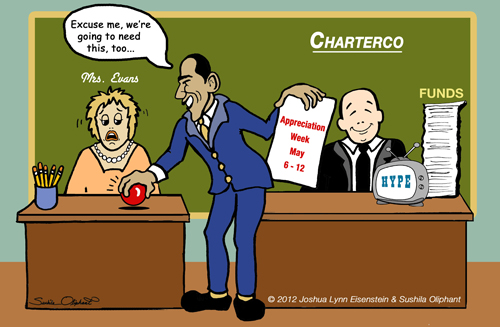
What Next?
At times it feels to rank-and-file teachers like the wealth and power of the entire nation is aligned against them. For me personally, May 7, 2012 was one of those times.
For those who don't know why, a bit of history: Almost a decade ago, to honor the increasing contribution of charter schools to American education during his first term, President George W. Bush began the concept of National Charter Schools Week. In 2003 this was held one week prior to National Teacher Appreciation Week. President Obama took the trend one step further this year, declaring a week for charter schools on the same week that has traditionally been devoted to teachers -- ALL teachers.
Continue Reading »
[ Posted Monday, May 21st, 2012 – 15:56 UTC ]
In a few weeks, California will hold its primary election. Not much news will be made, since the two major parties' presidential candidates are already known. But this election will be different for Californians in a major way. Because when the general election rolls around in November, there will likely be no third parties on the ballot for voters to choose from. Furthermore, in some races, there may be only one party represented on the general election ballot.
The reason is that California is in the midst of a political science experiment. The voters passed Proposition 14, which mandated a scheme known as "Top 2" voting. Explaining it is pretty simple, but what it could mean is a lot more complicated. In the primary election, all parties are free to put up as many candidates as they like for any particular office, as usual. But only the top two vote-getters -- from all parties combined -- will advance to the general election. In essence, the primary becomes the general election, and the general election becomes a runoff vote between the top two candidates.
While the presidential race is exempt from this scheme (presidential candidates from all parties will be on the general election ballot, as usual), most other offices will use "Top 2" voting: U.S. Senate, U.S. House of Representatives, and all state races (legislative and executive). What this means, for example, is that Dianne Feinstein may be facing a fellow Democrat on the ballot this November, with no Republican (or Green, or Libertarian) on the ballot at all.
Continue Reading »
[ Posted Friday, May 18th, 2012 – 16:17 UTC ]
So, it's official. Disco is dead. The passing of Donna Summer brings to a close an era in American music that... well... if you didn't live through it, it's hard to explain. Especially the outfits people wore in public. And making John Travolta a movie star (although he did atone somewhat, by genuflecting to the 1950s immediately thereafter, in Grease).
Music history aside, it was a somewhat eclectic week in politics. The House -- in one of their rare moments when they actually meet and attempt to get something done -- passed a bunch of bills which have exactly zero chance of becoming law. Well, at least they had fun, right? Republicans were doing their usual clown routine out on the campaign trail, including questioning Obama's commitment to America and (once again) his birth certificate.
Sigh. The more things change, the more the clown makeup remains the same, I suppose. On a lighter note in clowning around, it seems arriving at a red carpet in a dog crate on top of a car is now chic. Heh.
Continue Reading »