[ Posted Tuesday, July 9th, 2013 – 16:26 UTC ]
[Program Note: I wrote this column a few months ago, and thought it'd be a good time to run it again, since the White House just released their own projection of the 2013 deficit this week. The White House is actually more pessimistic than the C.B.O., which is kind of refreshing since, previous to Obama's term, the White House (under Republican and Democratic presidents, I should point out) would routinely present the most optimistic figures, for obvious political reasons. Obama's White House is more cautious, preferring to let the C.B.O. be the optimists. The figures the White House just released: a 2013 deficit of $759 billion, which is down over $200 billion from their previous estimate, earlier this year. So while nobody really can say for certain what this year's budget deficit will be, it is looking more and more likely that it'll be a lot better than anyone thought last year. For instance: we have not had a gigantic political fight over the debt ceiling yet this year -- because we haven't had to. We're not going to hit the debt ceiling until the end of this fiscal year, most likely. Without these improving numbers, that simply would not have been true. In any case, I thought it was a good time to re-run this, chart and all.]
Originally published May 14, 2013
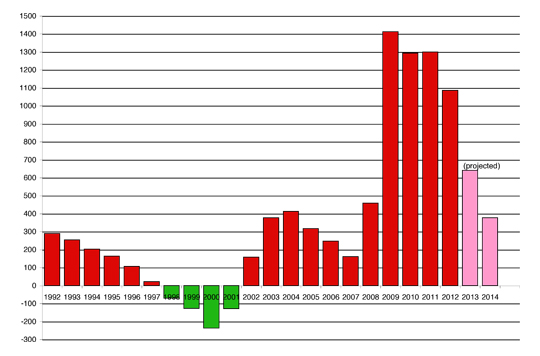
Looks like I spoke too soon. Last Thursday, I posted an article about the expected good news on the federal budget deficit for 2013. Today, the actual numbers were released. They are even better than expected.
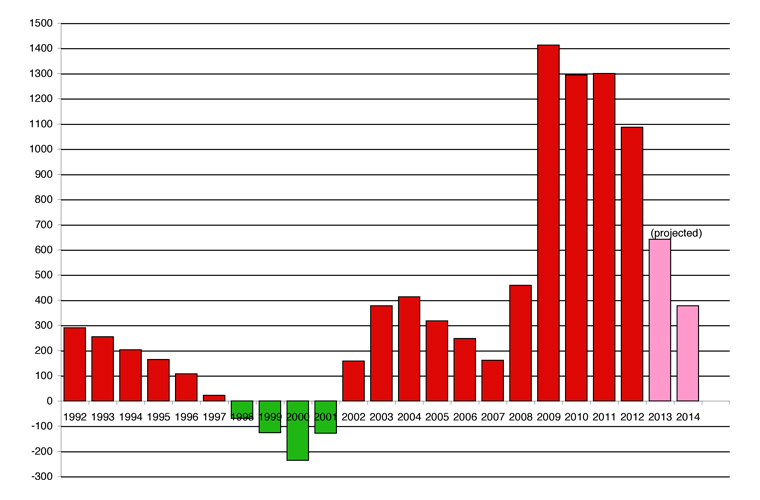
After churning the data for the first two quarters of fiscal year 2013, the Congressional Budget Office is now predicting a deficit of $642 billion this year. This is down over $200 billion from their first-quarter estimate, mind you. They are also projecting a deficit of only $378 billion for next year.
As is my wont, I decided to put this into chart form, so here you go:
[Click on graph to see larger-scale version.]
Continue Reading »
[ Posted Monday, July 8th, 2013 – 16:35 UTC ]
Speaker of the House John Boehner faces a dilemma on how to proceed on immigration policy, and no matter what course of action he chooses, he is all but certain to disappoint a large part of his own party. Although the immigration issue is new, the dilemma is not. In fact, it's the same dilemma Boehner has faced on multiple issues ever since he picked up the speaker's gavel: do what the Tea Party wing of the Republicans wants, or do what the Republican Party establishment wants. While this division has shown up repeatedly, it seems to be much more stark on the question of immigration -- which doesn't exactly bode well for Boehner.
Boehner has three basic choices available to him (although, due to the parliamentary process, he could wind up choosing more than one of them). The first choice is to do nothing. This is something Boehner's House is very good at, in fact, so it could wind up being the default choice. The House could make a lot of noise over immigration, and wind up not passing anything. There's another reason why this could become the default choice, too -- there are so many options to choose from which all have the same "do nothing" result at the end of the day. Bills can die in committee, bills can be approved by committee and then never make it to the House floor (something Boehner directly controls), or the bills which do make it to the floor can be so bad that they fail to even get passed due to Republican defections.
Continue Reading »
[ Posted Friday, July 5th, 2013 – 17:47 UTC ]
Maybe it's just envy. I'll fully admit it, up front. After all, who wouldn't want a job where you get one-third of the time you're supposed to be working as free vacation days? Nice work, if you can find it. So maybe there's a tinge of envy which propels me, on a semi-annual basis, to essentially air the same complaint. But the regularity of these rants is also due to the fact that not much changes in Washington, ever, and one of the reasons that Congress just doesn't work these days is that Congress just doesn't work all that much.
We'll start with the numbers. From the beginning of this year to the last day in June -- exactly one-half of the year -- there were 181 days on the calendar. Subtracting weekends brings this total down to 129 days. In the first half of the year, there were five federal holidays (one more than usual, due to the year having a presidential Inauguration Day). This leaves us with 124 workdays.
The House managed to work on 84 of these days. The Senate only chalked up 78 days of doing business. That is, respectively, 67.7 percent and 62.9 percent, which is pretty dismal when you consider how much paid vacation the average American worker gets. The House was on vacation (to put it another way) for 40 days so far this year, and the Senate took 46 days off. Out of almost 25 full workweeks, the House took off eight of them and the Senate took off more than nine full weeks.
Continue Reading »
[ Posted Thursday, July 4th, 2013 – 09:00 UTC ]
[Program Note: I wrote this column for the Fourth of 2007, but it's still a pretty good read to get you in the mood for today's celebrations. Have a great holiday everyone, and see you back here tomorrow when new columns resume.]
We hold these truths to be self-evident, that all men are created equal, that they are endowed by their Creator with certain unalienable Rights, that among these are Life, Liberty and the pursuit of Happiness.
-- Preamble to the Declaration of Independence
That line will be widely quoted across this land today, in parks and bandstands, on radio and in newsprint, from California to the New York islands, in countless big-city parades and from a myriad of small-town gazebos.
The more serious-minded of these proclaimers will go on to read the entire text of the Declaration which began the idea of the United States of America. It's an interesting text to read, and if you haven't read it since Junior High, I certainly encourage you to do so. There are obvious parallels in the deprivations of King George III which may sound uncomfortably apt today, for various reasons.
Continue Reading »
[ Posted Wednesday, July 3rd, 2013 – 15:47 UTC ]
[Program Note: Since Independence Day is midweek this year, we're going to knock off early and run repeat columns both today and tomorrow. Neither one of these has been re-run before, so for different reasons we thought it'd be appropriate to do so this week. The first was (quite obviously) written during last year's presidential election campaign to make a snarky little point, but the underlying story is still an interesting one even though we don't hear Mitt's name in the news quite so much these days. Tomorrow's column is one of the earliest "holiday" columns I ever wrote, and I can't believe I haven't run it again before now, because it is so uplifting in nature. In any case, enjoy a little American history and we'll see you back here on Friday as we resume new columns once again.]
The name "Romney" has historical significance in Massachusetts, but the story goes back a lot further than just a recent ex-governor. In fact, a "Romney" played a significant part in the American Revolution -- on the British side. The name, however, does not refer to a man, but rather to a man-of-war, the H.M.S. Romney, a 50-gun British ship that sailed into Boston harbor in 1768.
The Romney was there for a specific reason -- to help the British government enforce the Townshend Acts. It was a show of force, for the benefit of those unruly Americans who were resisting Parliament's new decrees.
Continue Reading »
[ Posted Tuesday, July 2nd, 2013 – 16:13 UTC ]
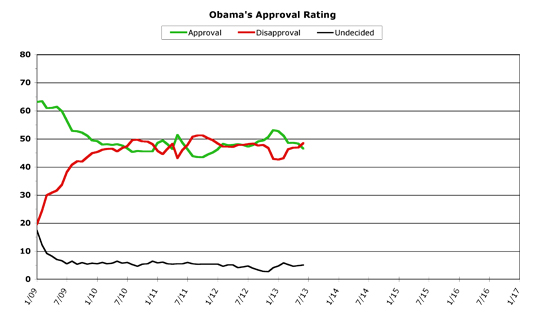
A big drop
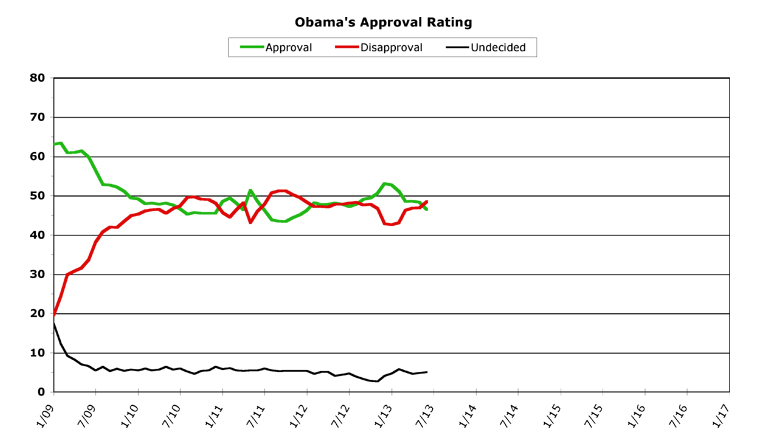
Welcome back to our monthly review of President Obama's job approval polling numbers. This is going to be an abbreviated version of our normal column, because it got squeezed out of the Monday slot by the 150th anniversary of the Battle of Gettysburg, so apologies for this month's brevity in advance. June wasn't a particularly good month for Obama's numbers -- in fact it was a fairly bad month for him, as his numbers went "underwater" for the first time in his second term. Let's take a look at this month's chart:
[Click on graph to see larger-scale version.]
June, 2013
Continue Reading »
[ Posted Monday, July 1st, 2013 – 17:51 UTC ]
Today, exactly 150 years ago, the Battle of Gettysburg began. Seen by most military historians as the turning point of the Civil War, the victory of North over South was indeed a profound moment in time. But I'm going to leave that sort of thing to the military historians who are much more informed about the battle itself, the meaningfulness of the victory, and all the rest of the arrows-on-a-map analysis. There should be plenty of such commentary this week to commemorate the battle, a three-day affair that left roughly 50,000 Americans dead. Instead, today I'm going to go off on a rather large tangent into the history of the American political world, so be warned.
President Lincoln, during a visit to the battlefield at Gettysburg over four months afterward (to dedicate a graveyard of the dead), said pretty much all that needs to be said about the true impact of the battle on the American psyche:
We are met on a great battlefield of that war. We have come to dedicate a portion of that field, as a final resting place for those who here gave their lives that that nation might live. It is altogether fitting and proper that we should do this. But, in a larger sense, we can not dedicate, we can not consecrate, we can not hallow this ground. The brave men, living and dead, who struggled here, have consecrated it, far above our poor power to add or detract.
Which is another reason why I'm not going to address the battle itself much, in contemplating the events of 150 (or, perhaps, "seven score and ten" would be more appropriate) years ago. As Lincoln pointed out, it's an almost-impossible task to achieve. Although these lines aren't the most-quoted lines from his speech, they are indeed the essence of it -- the soldiers who fought here paid the ultimate price, and everything we do in commemoration is always going to fall short of that measure.
Continue Reading »
[ Posted Friday, June 28th, 2013 – 17:09 UTC ]
Well, we've been away for two weeks, and those two weeks were just chock-full of political news, so we've got a lot to cover. The reason for the interruption in columns was, of course, our attending Netroots Nation, the yearly conclave of bloggers, Progressives, and all and sundry who like hanging out with them. Which brings us to this week's unusual title -- today's Friday Talking Points, for the first time ever, are going to be professionally-produced and focus-group-tested. More on this later.
We've got a lot to cover, so we're going to do it very quickly here, but I have to begin by pointing out, once again, what a helium-brain David Gregory truly is. The moderator of Meet The Press is a journalistic lightweight on his best of days -- even when some interviewee breaks some real news on his show, Gregory can be counted on to not realize such news has been made, at least until someone else informs him of the fact. The man couldn't think his way out of a paper bag, although he does have that boyish grin and good hair going for him -- which is all that really matters to NBC.
Continue Reading »
[ Posted Thursday, June 27th, 2013 – 16:24 UTC ]
They wanted 70, and they got 68. I speak, of course, of the "yea" votes in the Senate on the immigration bill this afternoon. In the political world we occupy today, that is nothing short of astounding. Not only did all 54 Democrats stand together, but 14 Republicans also voted in favor of the bill. That's 10 more than were in the original group which put together the proposal. Which, as I said, is truly astounding in this partisan day and age.
Is the bill perfect? Well, no. But then keep in mind that no bill ever is. Will it do more good than harm? As written, the answer seems to be an unqualified "yes." Sure, Democrats had to toss in 20,000 Border Patrol agents (a doubling of the force) at the cost of $30 billion, but they had to let the Republicans spend a bunch of money to get them on board. Democrats allowed the Republicans to prove once again that their denouncements of deficit spending always ring hollow when it comes to things Republicans want to spend money on. Thirty billion dollars is a cheap price to pay, though, since the non-partisan Congressional Budget Office projects that the bill will save over $900 billion from the federal budget over the next two decades.
I've been following the progress of the immigration debate all year, and have to say that the hurdle the Senate cleared today was monumental. Not only did the bill pass, but it passed with substantial bipartisan support. What other contentious issue has passed the Senate recently with 68 votes, after all? None that spring to my mind, that's for sure. It appears there are at least 14 Republican senators who realize that their party's future could hang in the balance, and voted in favor of all those aspiring to be United States citizens. The Senate has laid out a clear roadmap to citizenship, which will benefit millions. And they did it with 30 percent of the Republicans in the Senate voting for it.
Continue Reading »
[ Posted Wednesday, June 26th, 2013 – 17:14 UTC ]
Today, my marriage to my wife did not change one iota. Our marriage does not need "protecting" or "defending" by anyone -- it is exactly the same today as it was yesterday. Tomorrow, it will remain the same. Contrary to the claims of opponents, the Supreme Court's landmark rulings on the two cases before it involving the rights of gay people to get married has had and will have no effect whatsoever upon my marriage.
That may sound like a strange place to begin the celebration over the Supreme Court's rulings in Hollingsworth v. Perry and United States v. Windsor, but it's a key point if only because it has been used as such an erroneous argument in favor of banning marriage equality. No heterosexual's right to marry the person of their choice is any different now than it was yesterday -- proving the opposition wrong on one of their main arguments (consider the name of the federal law, for proof of this: "Defense Of Marriage Act"). But the whole argument over marriage equality is so personal, I thought I'd start with my own personal take on it: the sun will rise tomorrow, I will be married to the same wonderful woman, and nothing will have changed. Nothing.
However, for a whole lot of gay couples, life will have gotten one whale of a lot better. Today's Supreme Court rulings are a giant leap forward along the path to fully equal rights. The federal government will now recognize marriages which their states recognize, and the barriers to equal treatment under federal law have disintegrated for good. That is indeed something to celebrate. Which is why I'm going to stop using the term "gay marriage" ever again in my writing. There is no "same-sex" and "opposite-sex" marriage anymore. There is just marriage, period. From now on, the phrase I'll be using is "marriage equality," because we're all now equal under federal law -- as we should be under state law, as well.
Continue Reading »