[ Posted Thursday, September 5th, 2013 – 16:00 UTC ]
Dog days of August
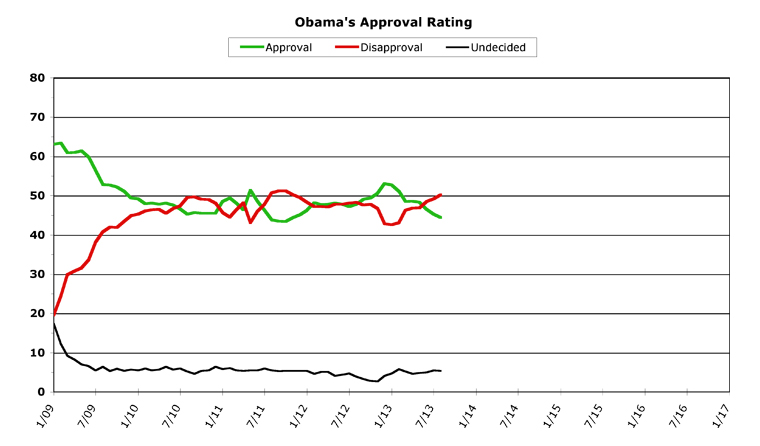
For President Obama, August is the cruelest month. Every year, without fail, Obama slumps in the polls in the dog days of summer. This year was no different. That's the bad news, for Obama fans. The worse news is that there isn't a whole lot on the immediate horizon which could give Obama any sort of bump upwards in his polling numbers. But before we get to the future, let's take a look at the past month.
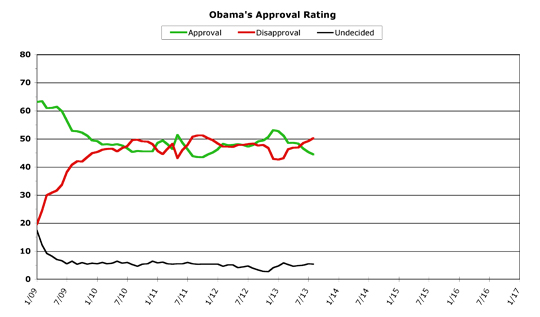
[Click on graph to see larger-scale version.]
August, 2013
Continue Reading »
[ Posted Wednesday, September 4th, 2013 – 15:11 UTC ]
The Senate Foreign Relations Committee just voted to approve a resolution to attack Syria on a vote of 10-7, with one member merely voting "present." But the breakdown of the voting reveals that this was in no way a party-line vote. Which, of course, complicates the issue for a media much more comfortable with a "horse race" mentality towards all politics ("Dems are up! GOP down! Film at eleven!"). For once, some complexities have emerged which confound the knee-jerk pigeonholing so regularly practiced by news producers. But maybe that's all to the good. Maybe, in fact, that's why President Obama went to Congress in the first place.
Continue Reading »
[ Posted Tuesday, September 3rd, 2013 – 16:36 UTC ]
Since I worked yesterday, on what was supposed to ostensibly be a holiday, I am taking today off. I will be answering comments from recent articles later, but won't be writing a new column today. Apologies for the interruption in our scheduling, normal columns will resume tomorrow. Either tomorrow or Thursday, we'll have our monthly Obama Poll Watch column, so you've got that to look forward to.
-- Chris Weigant
Follow Chris on Twitter: @ChrisWeigant
[ Posted Monday, September 2nd, 2013 – 15:39 UTC ]
President Obama, it seems, has confounded congressional Republicans by giving them exactly what they asked for, on the subject of Syria. "Consult Congress!" they bellowed last week, full of constitutional righteousness. "OK, let's have a vote," Obama responded. Now the cry, from at least one, is "Obama is hiding behind Congress!"
Sigh. Seems like they're against whatever Obama's for, but that's not exactly a new thing, is it?
To be fair, the Syria issue is not a cut-and-dried partisan thing, so giving in to the snarky urge in that first paragraph is not totally justified. There are anti-war Democrats, there are pro-war Democrats, and there are Republicans equally all over the map on the issue. So it's really a problem with Congress as a whole rather than just one party. Also, that's not even what I wanted to talk about this Labor Day, so let's just start over, shall we?
Congress -- even in a good year -- barely works. That can be taken (equally correctly) either as "barely functions" or "barely ever shows up for work." In a pathetically-unproductive year (this Congress is on track to be the least productive Congress since records were kept), this should already have become painfully obvious to all.
Consider the fact that the inside-the-Beltway conventional wisdom, as late as last Thursday, had not only convinced itself exactly how we were going to strike Syria, but also when we were going to attack (the consensus: Obama had to strike before he flies off to St. Petersburg for an international meeting). As happens with regularity, the inside-the-Beltway consensus was wrong. President Obama didn't get their memo, or something.
But rather than discussing the pros and cons of striking Syria today, we have to point out something which should be glaringly obvious even inside the Beltway, but will likely get short shrift -- namely, that Congress will be continuing their fifth week of vacation rather than returning to Washington to vote on whether America should go to war or not.
Continue Reading »
[ Posted Friday, August 30th, 2013 – 17:09 UTC ]
A "screed" is today generally understood to be a long and quite possibly boring speech or essay. Synonyms usually offered up by dictionaries include such derogatory terms as: "harangue, diatribe, rant," and definitions are chock-full of modifiers such as: "monotonous, long, tedious." The root form of the word actually comes from the Old English word for "shred," screade, which migrated into Middle English as screde, meaning "a fragment or strip of cloth." The first recorded use of the word in the modern sense was in 1789 -- the same year the United States Constitution was ratified -- where it was taken to mean "reading from a long list," perhaps written on such a shred of cloth.
So, did that paragraph set the stage, or what? Long... check. Monotonous or tedious... check. Diatribe? Well, that's coming, never fear....
This is all by way of introducing you to today's column. We're throwing out our usual format today, because of a monumental shift in federal policy this week. Such a momentous and historic occasion deserves special treatment, we feel, and that special treatment translates to the following unorthodox presentation: first, a few awards; then, some talking points from respected voices; and finally, my own screed at the end.
The subject under the microscope today is marijuana, and (in particular) the federal government's views and actions towards this issue. Enjoy, or be warned -- that's pretty much going to be "it" for this week. Don't complain later, if you were expecting our weekly nonsense today, that's all we have to say by way of introduction.
Continue Reading »
[ Posted Thursday, August 29th, 2013 – 13:51 UTC ]
It's a new day in America.
Today will be marked in history as the day the federal government finally realized that their 80-90 year war on a plant is not only ineffective and counterproductive, but also a gigantic waste of money and everyone's time.
Attorney General Eric Holder -- the nation's chief law enforcement officer -- announced today that the Department of Justice would not challenge state laws enacted by popular vote in the states of Washington and Colorado which legalized cannabis for adult recreational use. The federal government will not sue the states in court to prevent the laws from fully being implemented, and they will not waste their resources prosecuting people in these states who follow the rules. In addition, Holder informed all 50 of the state-level attorneys general that the Justice Department was issuing new guidelines for how federal prosecutors will prioritize enforcement efforts in the forty percent of the country where medicinal marijuana is now legal at the state level.
While this is not exactly the ratification of the 21st Amendment, it is indeed a historic turning point in the Marihuana Prohibition Era (using the original anti-cannabis terminology, to give the period the full century-old flavor it truly deserves). This is the first significant step the federal government has taken in almost a century which loosens rather than tightens federal law-enforcement efforts towards cannabis. While marijuana will remain illegal under federal law -- under the strictest rules of any "controlled dangerous substance" -- Holder has announced that in states where the citizens have plainly shown at the ballot box their disapproval of such federal laws, the federal government will now back off. Thus begins an end to the insanity of the War On Weed. Think "insanity" is too strong a term? Consider the fact that under federal law marijuana is considered more dangerous than the following: cocaine, opium, amphetamine, methamphetamine, and PCP. That is, truly, nothing short of insanity.
Continue Reading »
[ Posted Wednesday, August 28th, 2013 – 17:27 UTC ]
Fifty years ago today, the Reverend Doctor Martin Luther King Junior gave a seminal speech. This anniversary has been marked today by many, by presidents and by bloggers alike. Many have taken as their springboard for commentary the immortal phrase "I have a dream," completing it with their own new dreams of justice and righteousness for America.
So it might seem a little surprising that today I have chosen to comment on a different King speech. King gave this speech at the conclusion of a march from Selma to Montgomery, in Alabama, on March 25, 1965. It is now known as the "Our God Is Marching On!" speech, since it closes with the words of the "Battle Hymn of the Republic." Towards the end of the speech, King poses a very basic question:
I know you are asking today: "How long will it take?" Somebody's asking: "How long will prejudice blind the visions of men, darken their understanding, and drive bright-eyed Wisdom from her sacred throne?" Somebody's asking: "When will wounded Justice, lying prostrate on the streets of Selma and Birmingham and communities all over the South, be lifted from this dust of shame to reign supreme among the children of men?" Somebody's asking: "When will the radiant star of hope be plunged against the nocturnal bosom of this lonely night, plucked from weary souls with chains of fear and the manacles of death? How long will Justice be crucified, and Truth bear it?"
Continue Reading »
[ Posted Tuesday, August 27th, 2013 – 17:51 UTC ]
I thought I'd go generic with the headline today, mostly because I do consider it shocking news when the mainstream media actually does something right these days. Especially in August, a month normally known for the silliness of the stories the media obsesses over. But this August has been surprisingly silly-free so far, leading to one of those "it's quiet out there... too quiet" tension-filled movie moments. Of course, this is ignoring the recent orgasmic behavior of the media over Miley Cyrus doing what dozens of female pop stars have done -- literally for decades now -- in an onstage performance. And make no mistake about it: I am ignoring all of the Cyrus-hating because it deserves to be ignored. Pop culture aside, even the political news has largely yawned over Republicans whimpering about impeachment and other such August sideshows. Even the rodeo clown story never really got traction. So, after an awfully slow and non-obsessive August, it is indeed refreshing to see our national news media -- collectively, even -- do something right in the reporting of actual news in a way that actually imparts important information to the public. Yes, journalists everywhere -- even on television! -- are incredibly living up to the basic definition of journalism. And all it took was one big fire.
Continue Reading »
[ Posted Monday, August 26th, 2013 – 16:57 UTC ]
Once again, the question on everyone's minds as they turn on their evening news is: "Are we at war yet?" This time, against Syria. Have the bombs started dropping? Have the sorties started? Have the cruise missiles been unleashed?
The conventional-wisdom mavens of Washington have already arrived at a consensus -- yes, we are going to attack Syria soon, but we'll do it from afar, with missiles and other means which reduce the military risk to American soldiers to zero. Think Libya, not Iraq, in other words.
What's astonishing in all this war chatter is that so few are asking the fundamental question any sort of "shock and awe" operation truly demands: "What happens after the bombing raid is over?" I certainly don't have the answer, but I'm holding out hope that President Obama and his national security team are at least seriously considering the question.
Continue Reading »
[ Posted Friday, August 23rd, 2013 – 17:19 UTC ]
Dog-lovers will have to wait for their portion of that headline until the awards part of the column; but as for the cats, I was struck this week by a funny comment on an article I was reading on the continuing civil war within the Republican Party -- written about how much they all hate Obamacare and (more importantly) how far they're willing to go to prove this to the nation. Unfortunately, I read this comment in passing and now can't even remember the article it was in response to, so I cannot adequately give credit where it is due. All I can say is the phrase is not original, and may have come from the comments to a Washington Post article online (maybe?).
The article detailed John Boehner's increasingly pretzel-like contortions in his attempt to have things both ways. The establishment Republicans have been pushing back very hard on the Tea Party radicals, because they know full well how the public would react to taking either the federal budget or the nation's creditworthiness hostage in a hissy fit over the looming full implementation of Obamacare. Boehner, like all Republicans who cling to whatever shreds of sanity the Tea Party still allows them to, thinks shutting the government down would be a bad idea, both practically (even if they did so, Obamacare funding wouldn't even be affected) and politically (see: Newt Gingrich, Bill Clinton).
Boehner keeps trying to allow the Tea Partiers their rhetorical red meat, while at the same time vowing that hostages won't actually be taken (or shot) by the House Republicans. Something's got to give, and we'll all be watching in September to see exactly what that will be. For now, though, the best description came from the aforementioned commenter, who wrote something along the lines of: "Boehner's trouble isn't even that he's trying to herd cats -- it's that he's trying to herd stupid insane cats."
You can see why that stuck in my memory. Best description I've heard yet to sum up John Boehner's entire speakership, really.
Continue Reading »