[ Posted Wednesday, June 4th, 2014 – 15:43 UTC ]
When one usually speaks of the "fog of war," the term is generally understood to mean the disorganization of combat. When battles are fought, it is often unclear as to what is going on, whether you're a private in the trenches or a rear-echelon officer trying to keep on top of a developing situation under your command. What is also understood is that after a while, the fog usually clears somewhat. Things which aren't immediately apparent become clarified when enough time has passed for accurate reports of the situation to come in.
In the case of recently released prisoner of war Sergeant Bowe Bergdahl, this progression was reversed. What at first seemed very clear-cut almost instantly became clouded in fog. This fog may clear some when the Army makes a formal statement about the circumstances of Bergdahl's capture by the Taliban, but until that point the speculation is running pretty wild. Due to this lack of facts, the most I can do is offer up my own points of view, some of which I have yet to see expressed elsewhere. So, while we all wait for the facts to come in and the fog to clear a bit, here are some initial reactions. I'm not going to get into every aspect of the case in this initial article, but I'm sure we'll all have time to minutely examine everything in the coming days. As I said, these are just my initial reactions -- the ones that I haven't been hearing from others yet. I'm sure to have more later, when the fog starts to clear a bit for us all.
Continue Reading »
[ Posted Tuesday, June 3rd, 2014 – 16:29 UTC ]
Today is primary election day in eight states across the land (including my own). The most media attention will be paid to the Mississippi Republican Senate primary, where the incumbent, Senator Thad Cochran, may be in trouble from a Tea Party challenger. So while the storyline a few weeks ago was "Establishment Republicans win big over Tea Party," the storyline tomorrow may be "Tea Party strikes back!"
As I wrote back then, it is getting tougher and tougher to accurately state the power of the Tea Party movement. Yes, some of their pet candidates got defeated in primary elections, but on the other hand they have successfully driven the entire Republican Party far to the right. The case can be made either way, really. And that doesn't even get into debating the accuracy of the "Tea Party" label, for each individual candidate.
Continue Reading »
[ Posted Monday, June 2nd, 2014 – 15:55 UTC ]
Slow recovery continues
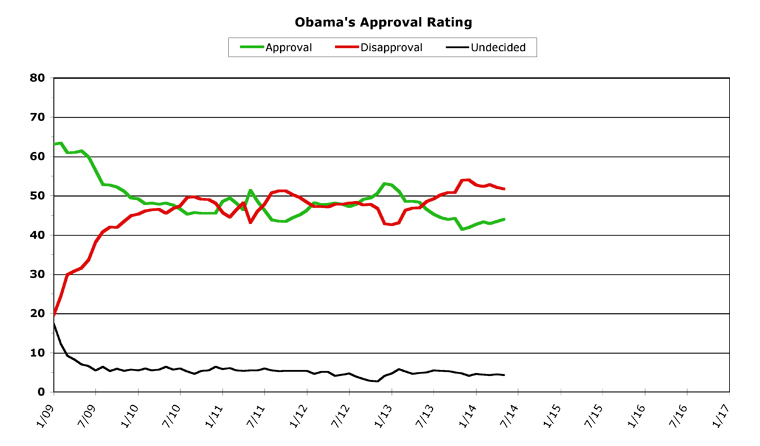
President Obama's job approval ratings continued to improve, slowly, in the month of May. In five out of the last six months, in fact, Obama's numbers have gotten better. He is now roughly where he was right before the impact of the Obamacare website rollout hit his approval rating. This is still not fantastic territory for any president's approval rating to be in, but it does represent a steady increase as Obama has won back people he lost in the Obamacare website disaster. However, this trend may now be flattening out, meaning June's numbers may not be as positive. But we're getting ahead of ourselves. Let's start with a look at last month's chart:
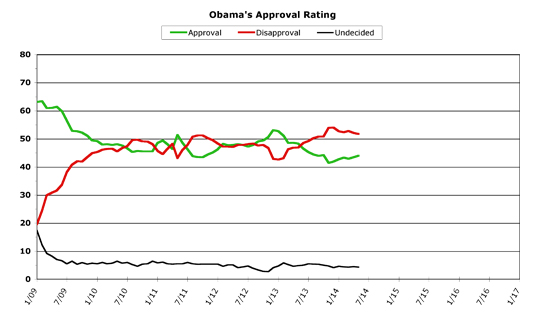
[Click on graph to see larger-scale version.]
May, 2014
Continue Reading »
[ Posted Friday, May 30th, 2014 – 17:02 UTC ]
It has been a momentous week, with the resignation (read: "firing") of a cabinet secretary, a presidential speech on America's foreign and military policy, and the announcement of a timetable to bring home the remaining troops in Afghanistan. Plus all the usual Washington squabbling. But one story risks being buried among all this other newsworthy stuff, and that is the vote which happened late last night in the House of Representatives. Because, with a healthy bipartisan majority, they just voted to end the war on medical marijuana forever. If the Senate follows their lead, this could be one of the biggest turning points in ending the federal War On Weed altogether. In other words, it is a momentous event.
The "Rohrabacher-Farr Amendment" was sponsored by Republican Dana Rohrabacher and Democrat Sam Farr, both from California -- the first state in the nation to legalize medical marijuana, almost two decades ago. It uses the traditional congressional "power of the purse" to ban the Justice Department from spending any money on arrests, raids, and prosecutions of medical marijuana providers and patients that comply with their states' medical marijuana laws. That's the entire Justice Department, including federal attorneys, the Drug Enforcement Agency, and the Federal Bureau of Investigation.
Continue Reading »
[ Posted Thursday, May 29th, 2014 – 16:19 UTC ]
The window of opportunity for comprehensive immigration reform to pass Congress is getting narrower, and is about to slam shut until (realistically) the year 2017. More accurately, if John Boehner doesn't allow the House to vote on a bill before the August congressional month-long vacation, then there is little-to-zero chance of immigration reform passing before our next president is sworn into office.
That sounds grim, because it is. If the House doesn't vote in the next few weeks, the chances of immigration reform passing get smaller and smaller, as time goes on. After August comes September and October, when Congress will be completely consumed with the upcoming midterm elections. That's a very polite way of saying "nothing will get done, folks." Certainly not something as contentious as immigration reform, right before people vote.
Continue Reading »
[ Posted Wednesday, May 28th, 2014 – 16:59 UTC ]
In the past month, the Obama White House has found itself at the center of two new scandals. While one is being (so far) treated as a minor matter, it may later grow in importance once Republicans wake up to the political embarrassment potential for the president. The second scandal is systemic and entrenched, and is going to require a lot of drastic action to fix. How Obama reacts to both the "outing" of the C.I.A. station chief in Afghanistan and the ongoing problems at the Veterans Administration will wind up reflecting on his presidential legacy, for better or worse.
Outing a top C.I.A. spymaster
Let's examine the minor scandal first, since it is easier to see what needs to be done. What happened is not entirely clear at this point, but here are the facts as they are currently known. President Obama just completed a secret trip to visit the troops in Afghanistan over the Memorial Day weekend. The story did not leak out before the trip happened. During the trip, however, a list was prepared of the people Obama had met while in Afghanistan. The Pentagon reportedly put the list together and handed it off to the White House. The White House press office then publicly released the list to their "pool" of White House journalists.
Continue Reading »
[ Posted Tuesday, May 27th, 2014 – 23:41 UTC ]
Important Question For All ChrisWeigant.com Readers:
Does anyone actually use the "Comments RSS" feed here? There may be a problem with it, and rather than dig into fixing it, it would be a lot easier for me to just turn this feature off.
But I will not do so if people are actively using it -- so PLEASE let me know right away if you use this feature of the website, below, in the comments.
Thanks, and sorry for the interruption.
-- Chris Weigant
[ Posted Tuesday, May 27th, 2014 – 15:22 UTC ]
Today President Barack Obama announced the beginning of the end of America's longest war. This announcement was fully anticipated and therefore came as no surprise, seeing as how Obama was elected in large part to end two wars. He successfully withdrew all American troops from Iraq in 2011, and he announced today the schedule for withdrawing American troops from Afghanistan. From 32,000 current troops, we will draw down to 9,800 by the end of this year. This number will then shrink by half (to roughly 5,000) by the end of 2015. By the end of 2016, they will all be out (except possibly for a small force left for security, in the range of 1,000 troops or less). Thus will end a 15-year-long war effort -- the longest in American history.
The troop reduction schedule is not going to please everyone, of course. Second-guessing our war plans is routinely done by both sides of the political spectrum. "Too fast!" one side cries, while the other will reliably respond with "Not fast enough!" Part of this is partisan posturing, of course. But the inescapable fact is that the American public lost interest in this conflict a long time ago.
Continue Reading »
[ Posted Monday, May 26th, 2014 – 14:58 UTC ]
I was all set to write an original Memorial Day column today, and had a subject lined up and everything, but then the subject matter and research just got too depressing. So instead, I'm re-running a column I wrote last summer, on the occasion of the 150th anniversary of the Battle of Gettysburg (and the larger 150th anniversary of the Civil War, which we are still in the midst of).
The theme of the column I intended to write was the historical record of how America has treated her veterans. This record is not exactly exemplary, to put it mildly. In fact, only one war in American history generated real legislative respect for the homecoming soldiers: World War II. The G.I. Bill was about the most generous treatment of veterans by the government in all of American history. While the Veterans Administration can trace its roots to the early 1800s, so can the problems veterans encountered trying to get what they felt was their due from the government, after the wars were over. My column would have told some of these stories (the worst example was undoubtedly the Bonus Army, a kind of early "Occupy" movement by World War I veterans who camped out in Washington as a political protest -- only to be forcibly removed by Generals Patton and MacArthur, commanding tanks and cavalry against American military veterans and their families).
Continue Reading »
[ Posted Friday, May 23rd, 2014 – 17:45 UTC ]
Before we begin, our sincere condolences to the George W. Bush family for the loss of former White House pet Miss Beazley, who died this week. As always, we are strictly non-partisan in our love for "First Dogs" and "First Cats," because we feel the president's (any president's) humanity can only be improved by having a pet to play with on occasion (the photo of Bush with Miss Beazley which accompanies that article shows exactly what we're talking about). As Harry Truman famously put it: "If you want a friend in Washington, get a dog." Our thoughts are with the Bush family in their time of loss.
OK, on to the more partisan slant on this week's news. We can even begin with a fairly non-partisan attack, on pretty much the entire Washington political class as well as all the media (excepting the Washington Post) for completely ignoring a story about Northrop Grumman overcharging the taxpayers to the tune of $100 million. While prominently reported by the Post, the story was quickly ignored by just about everyone else. Which is a travesty, really. The contract in question was for counter-narcoterrorism, ironically (since we complain about "corruption" in all those other countries so often), and included one employee who billed $176,900 for 1,208 hours in a 12-day period. In other words, more than 100 hours per day. To fight all those corrupt regimes down south, it is assumed. Still waiting for a congressional committee to be announced to look into this, but I'm not exactly holding my breath.
Continue Reading »