ChrisWeigant.com

He Is Us

[ Posted Thursday, February 3rd, 2011 – 18:49 UTC ]

Egypt, it seems, is failing to follow a convenient storyline for the American journalists to follow.

When the American television media woke up and realized something was going on in Egypt (approximately two or three days after it all started, and long after Al Jazeera was covering it wall-to-wall, it bears mentioning), their first thought was to be the first network to get an anchor to Cairo. Brian Williams apparently won this race, much to the consternation (one assumes) of his competitors.

This silly race happens whenever a truly big story breaks elsewhere in the world where Americans might actually care what is happening, and where four-star hotels exist. Note the qualifications -- stories which happen which are virtually the same as what is going on now in Egypt are routinely ignored by the big network anchors, when they happen in some godforsaken place that not one in a thousand Americans could locate on the world map. Even when such stories do happen, it seems the big anchors are only willing to cover it when there's a convenient posh hotel nearby in which to barricade themselves should the going get rough (and then, one assumes, complain about the slow response of room service).

Continue Reading »

Obama Poll Watch -- January, 2011

[ Posted Tuesday, February 1st, 2011 – 22:48 UTC ]

Obama's best month ever

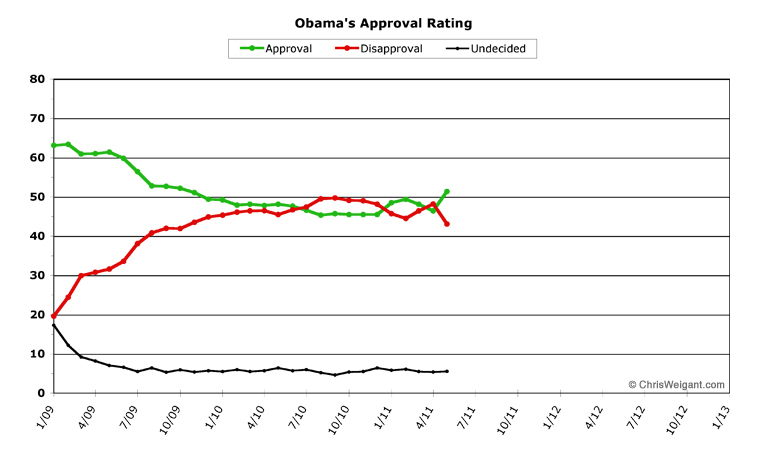
Obama poll-watchers have been waiting to see a "bump" upward in public opinion job approval ratings pretty much ever since he took office. In two years, there really hasn't been one. Until now.

In January, President Obama's approval rating went significantly higher, while his disapproval rating continued a trend of dropping with a big spike downward. What both of these meant, taken together, is that Obama is once again "above water" in the polls, with his approval rating beating his disapproval rating. This hasn't happened since last June. But, in reality, Obama has pretty much erased his past entire year's slow slide in poll numbers -- in a single month. Obviously, he didn't hit an all-time high in absolute numbers, but still, when taken month-to-month, January, 2011 was Obama's best month of his entire presidency. Not only did he finally get his bump -- but it was a truly significant bump.

Let's take a look at the chart:

Obama Approval -- January 2011

[Click on graph to see larger-scale version.]

Continue Reading »

Tunisami!

[ Posted Tuesday, February 1st, 2011 – 17:35 UTC ]

Forgive me for being somewhat irreverent today (if not downright irrelevant), but I only have time for a quick note as I'm busy putting together tomorrow's "Obama Poll Watch" column (which is, I have to admit, a fun column to write and hopefully will be a fun one to read as well).

Two completely trivial things struck me while watching the ongoing "people power" movements in North Africa and the Middle East this week. The first was that it seems that more and more revolutions/people power movements today are color-coded. It makes perfect sense, from a sheer marketing perspective, and also from a crowd's perspective. If the movement chooses a color to rally around early on, then it's a lot easier to see who on the streets is on your side and who may not be. Militaries throughout history have used this principle in the color of their uniforms, for instance. But, increasingly, it seems that revolutionary movements also are self-identifying with a color (or, sometimes, colors).

The first modern people power movement using a color which I'm aware of (I'm not counting as far back as the "White Russians," I should mention) was in the Philippines in 1986, when the "Yellow Revolution" (or "People Power Revolution") brought Corazon Aquino to power. Crowds of people wearing yellow cheered this development, as I recall. Since then, we've had a Rose Revolution (Georgia, 2003-04), an Orange Revolution (Ukraine, 2004), a Pink Revolution (Kyrgyzstan, 2005), and a failed Green Revolution (Iran, 2009). Some also call voting in Iraq a "Purple Revolution" (due to the purple ink on the fingers in the voting process), but this label never really widely caught on.

And now we've got a Jasmine Revolution in Tunisia inspiring others in the region (in Egypt, Yemen, Algeria, Jordan, and likely elsewhere before it ends). Currently, the world is focused on Egypt, but as far as I can tell the people in the streets of Cairo haven't color-coded their revolution yet.

One wonders, in the future, what is going to happen when all the familiar colors have been used up by other countries. Will they begin a two-tone scheme (the Blue-Yellow Revolution), or go with ever-increasingly obscure colors (the Teal Revolution, the Fuchsia Revolution, the Ecru Revolution)?

Inane wonderings aside, though (hey, I already apologized for this column in advance...), I do have to point out one bit of brilliant wordplay and "branding," which apparently is now being used in Egypt -- but also which the American media hasn't really noticed yet. Because it covers not just each individual revolution/people power movement, but rather is a meta-term which describes the entire wave of movements sweeping the region: a "Tunisami."

This term has several things going for it, not least of which is the cutesiness factor. The whole thing started in Tunisia, after all. And the "wave/tsunami" imagery is pretty good and pretty accurate in terms of describing how things are spreading.

So, while I sincerely do hope to be forgiven for such trivialism in the midst of history being made, I would like to encourage everyone to start using this brilliant term to describe this historic era: the "Tunisami" of 2011.


-- Chris Weigant

Follow Chris on Twitter: @ChrisWeigant

 

Democracy's Drawback

[ Posted Monday, January 31st, 2011 – 16:15 UTC ]

America is a strong supporter of democracy worldwide. Except, of course, when we aren't. That piece of doublethink has been at the center of American foreign policy pretty much since World War II, and it is the heart of the conundrum we now find ourselves in regards to what is happening in Egypt and other countries in North Africa and the Middle East. Because we're conceptually all in favor of democracy -- right up until the "wrong" person or group wins an election. According to our definition of "wrong," of course. This is the key drawback to democracy (and American support of democracy in the rest of the world) -- sometimes the "wrong" people win.

At heart of this dichotomy is the realpolitik fact that America promotes its own ideals and values, while simultaneously looking out for its own national interests. When the two conflict, we almost always choose our national interests (as we see them at the time) over our lofty ideals. Sometimes this leads to disaster, sometimes it leads to stability, and sometimes it leads to an American president pulled in two different directions -- as President Obama is right now over the Egyptian protests.

Continue Reading »

Friday Talking Points [153] -- SOTU-palooza

[ Posted Friday, January 28th, 2011 – 12:38 UTC ]

The past week in politics was, quite obviously, dominated by President Obama's "State Of The Union" speech to Congress. For those of you who may have been in a coma, here is a quick recap of the messages of Obama's speech, the official Republican response from Representative Paul Ryan, and the unofficial Tea Party Republican response from Representative Michele Bachmann:

Obama: "We can make the future so bright that O.S.H.A. will require us all to wear shades to view it."

Ryan: "Be afraid. Be very afraid! The Day of Reckoning is at hand!"

Bachmann: "Which camera? That one over there?"

This is only a slight exaggeration, I should mention. Ryan actually did use the phrase "Day of Reckoning" in his speech, believe it or not. You just can't make this stuff up, folks.

Of course, the public mostly noticed Obama's joke about fish. Sigh. You can't make things like that up, either.

Continue Reading »

A Spacey Three-Dot Thursday

[ Posted Thursday, January 27th, 2011 – 18:49 UTC ]

OK, it's going to a be a quick and disjointed column today, because I have to get tomorrow's Friday column done early tonight. So we return to the "three-dot column" format pioneered by the intrepid Herb Caen of San Francisco newspaper fame (who also famously coined the term "beatnik," by the way...). Today, we've got two Sputnik footnotes, a Sarah Palin chuckle, and a quick note on Obama's "ask the president a question on YouTube" session. Without further ado...

Continue Reading »

Obama's New Ideas

[ Posted Wednesday, January 26th, 2011 – 16:57 UTC ]

[Program Note: "State Of The Union Week" continues today, with a look at a handful of new ideas from President Obama's speech last night. I wrote an insta-reaction to the speech yesterday, and I will be examining the specific language of the speech this Friday, but today I wanted to highlight a few things that many in the media world seem to have missed from last night's speech. President Obama proposed a number of ideas last night, amongst the continuation of themes or policies he has pushed previously. The following are the proposals which stuck out (to me) as being truly new ideas for him, and thus worth examining.]


The day after President Obama's big yearly speech to Congress and the American people, most pundits and talking-head types in the media are vying to outdo each other on stating "what it all means" or similar high-flown overanalysis. What many of them seem to have missed, however, is the fact that Obama used his speech to introduce a few topics into the political debate. Some of these topics have been around for a while, championed by various people and groups, but what seems newsworthy to me is the fact that Obama included them in his list of proposals for the future.

Continue Reading »

A Different Kind Of Speech

[ Posted Tuesday, January 25th, 2011 – 22:02 UTC ]

[Program Note: I haven't done one of these "snap reaction" columns in a while, so I thought I'd try again tonight. It's not exactly "live-blogging," more "just after-the-fact" blogging, I guess. In any case, I'm not going to be examining the transcript of the speech itself here, but rather my general impressions after watching it. I like to write these before reading what others had to say about the speech, so I'm not influenced by what others think. I did watch some of the network responses tonight, and the Paul Ryan "Day of Reckoning" response speech (shudder), but not the Michele Bachmann Tea Party response (double-shudder). I'll get to examining the speech itself in detail later in the week, I promise.]


I'd have to sum up my immediate reaction to tonight's State Of The Union speech with the old Monty Python line: ".... and now, for something completely different ..."

Continue Reading »

"State Of The Union" Predictions

[ Posted Monday, January 24th, 2011 – 18:01 UTC ]

Well, it's that time of year again. The time of year when pundits across the land helpfully (oh, so helpfully) offer the president advice on what he should say in his "State Of The Union" speech tomorrow. While I've engaged in this sort of thing before, this year I'd like to make predictions of what President Obama will say tomorrow night (as opposed to what I would like him to say). Which means I'm not endorsing any of this personally, merely attempting to predict what will be in tomorrow night's speech in advance.

The overarching theme of tomorrow's speech (which I'm going to call the "SOTU" because it is much easier to type) will be jobs and the economy. Obama himself previewed this over the weekend, so this is a pretty safe guess. The president will be putting this emphasis on jobs into a framework he tested out last month -- the "Sputnik moment" speech he gave in North Carolina at the beginning of December.

Continue Reading »

Friday Talking Points [152] -- A Palin-Free Month?

[ Posted Friday, January 21st, 2011 – 17:48 UTC ]

With some regularity, this column excoriates the mainstream news media for all sorts of continued idiocy in the way it conducts its business. But every once in a while, we have to applaud them when they get something right. This week, Dana Milbank of The Washington Post deserves mentioning, for pledging to stay Palin-free for the month of February. Details on this in a moment.

It's rare for members of the media to perform such self-examination (and self-criticism). Especially when examining their own culpability in creating a situation. Much like vapid celebrities who are "famous for being famous" (the Paris Hiltons and Kardashians of the world), Sarah Palin is without a doubt the most famous Republican in the land -- and has been ever since John McCain announced her selection as running mate in 2008. Why this continues to be so is kind of mystifying. Palin isn't even in public office anymore, and yet the entire media world waits with bated breath for any tweet or Facebook posting from Mama Grizzly Central -- and then treats it as a major, major story immediately upon receipt. Think about it -- what other political figure in your memory has had their election "picks" tracked by major national newspapers during an election cycle (an election which Palin wasn't even directly participating in any way other than casting a ballot, it bears mentioning)? None that I can name. What other out-of-work politician is elevated to the same level as the president during a national event, as Palin was with her speech on the Arizona tragedy? Again, none that I can name.

Continue Reading »