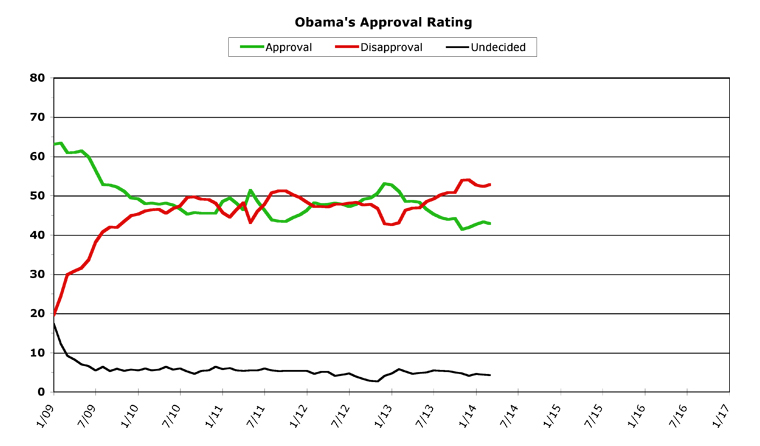
[ Posted Thursday, April 10th, 2014 – 17:00 UTC ]
To borrow (or, more accurately, "to blatantly steal") a phrase: "It's a great day for America!"
Those of you who understand why that previous sentence (in relation to this article's title) is a joke, please keep reading. Those of you who don't, well, I apologize because this column has seemingly wandered into some sort of Bizarro World, what with two columns discussing popular television programs this week (which has to be, to put it mildly, a first here at CW.com). Today, the subject du jour is late-night television, specifically that which airs on CBS. So if you're one of those people who never watches such things at midnight (or thereabouts), then I would strongly suggest you occupy your time today with other things than this column. Seriously, even watching a funny cat video will likely be a more productive use of your time.
Where was I? Oh, right... the greatness of today for America.
Continue Reading »
[ Posted Wednesday, April 9th, 2014 – 16:43 UTC ]
Congress is now doing what it normally does, in an election year. This is not intended to sound cynical, as I actually think it is a good thing for a divided Congress to stand up for its divided beliefs -- even while knowing that almost none of the bills it now votes on have a prayer of becoming law before the election. But these bills do serve an important purpose, and that is to define the two parties' differing agendas and priorities for the campaign. The clearer the picture that emerges between Democrats and Republicans, the better idea the citizenry has of what it is supporting in the ballot box, come November. So I actually welcome all the posturing which is now happening in both houses.
Continue Reading »
[ Posted Tuesday, April 8th, 2014 – 16:10 UTC ]
I take a look at when things really begin to change, is when the social culture changes. I think Will And Grace probably did more to educate the American public than almost anything anybody's ever done so far.
-- Vice President Joe Biden
Less than two years ago (it seems longer, but it's not), Vice President Joe Biden responded to a question about gay marriage in a Meet The Press interview. The quote above was taken from his answer (I provided the whole answer in an article I wrote about it back then). At the time, it was big news, due to the upcoming presidential election. President Obama, a few days later, gave his first statement supporting gay marriage (where he famously "evolved" on the issue), which was even bigger news.
Continue Reading »
[ Posted Monday, April 7th, 2014 – 17:29 UTC ]
We are in the midst of a political battle over the Obamacare numbers right now, so it seemed like a good time to examine what they all mean, in an attempt to interject some clarity into a very confusing debate. The numbers will change over time, as will (no doubt) the claims made from both sides of the debate; but without a little context the numbers by themselves don't actually say much. And as time goes by, one particular number will become the most important of all the data -- and this number just got better today (more on this at the end).
Obama's big number
The first thing worth pointing out is that the big number everyone's currently arguing about -- the 7.1 million signups on the Obamacare exchanges -- is a tough number to put together, but it would have been even tougher to aggregate if Obamacare had worked as originally designed. One of the big complaints from the anti-Obamacare camp is that the signup numbers aren't complete (in various ways), and haven't been sufficiently broken down into subgroups for full analysis. This contradicts one of their own talking points about Obamacare (that it was a "big government takeover" of the health insurance marketplace), since the very reason the numbers aren't complete is that data must be accumulated from all the insurance companies participating in the exchanges. The Obamacare website doesn't measure who has yet paid for their insurance, for instance, because it is up to the insurance companies themselves to collect the money, and not the government. But the real irony is that the 7.1 million figure would have been a lot harder to add up (and would have taken much more time to release) if we currently had 50 state exchanges, as was intended by the law's authors.
Continue Reading »
[ Posted Friday, April 4th, 2014 – 17:04 UTC ]
Today we're turning over the whole talking points section to the president, because he certainly deserves a victory lap after announcing this week that -- against all odds, and against all the slings and arrows of misfortune -- 7.1 million people signed up for health insurance on the Obamacare exchanges.
Because this will pre-empt our normal talking points, I'd like to point one thing out up front. Democrats, from this point on, should adopt a very simple technique to disarm Republican squabbles about Obamacare numbers. To every figure quoted for people gaining health insurance, Democrats should end with "...and counting." This is an easy miniature talking point to insert into any discussion of the numbers, using just two little words to point out a basic fact: these numbers are only going to grow over time. The deadline for signups was extended for just about everybody, so another two weeks of data will be announced later this month. After that, people will still be using the exchanges to buy insurance when their life situation changes (getting married, new job, whatever) outside of the open enrollment period. Which means the number will be even higher than 7.1 million by the start of the next open enrollment period later this year.
It's an easy way to make a big point. "The figure for signups is 7.1 million... and counting...." So every Democrat out on the campaign trail or on television should use these significant two words as often as possible when talking about Obamacare's numbers in the next few months.
Continue Reading »
[ Posted Thursday, April 3rd, 2014 – 16:36 UTC ]
Today's column is going to consist of what television sitcoms call a "clip show." This is when they present some thin uber-storyline in the plot which allows them to fill most of the show with "clips from the past," thereby avoiding having to write, act, shoot, and produce a full version of their show for that particular week. So, to put this another way: you have been warned.
The reason for this recycling is our version of President Obama's "spiking the football" this week, in his announcement that Obamacare had astoundingly met the original Congressional Budget Office goal of signing up over seven million people in the first open enrollment period. Call it Obama bragging about Obamacare's "vital statistics." What we're going to do today is review the last nine months of our own predictions on not just Obamacare but the politics of Obamacare, heading into the 2014 midterm election season. If you don't want to read all these excerpts, here's a short version that could fit on Twitter: The politics of Obamacare are now going to pivot to real data instead of Republican doom-and-gloom horror stories.
Continue Reading »
[ Posted Wednesday, April 2nd, 2014 – 16:44 UTC ]
The new normal?
President Obama's job approval polling was down a bit last month, ending three months of positive news. He didn't slip back much, but the reversal does bring up a serious question: is Obama stuck in a "new normal" of job approval numbers in the low-40s range? We'll take a look at possible answers to this in a moment, but first let's take a look at the new monthly chart.
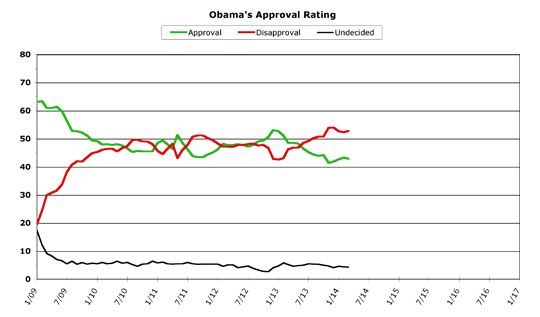
[Click on graph to see larger-scale version.]
March, 2014
Continue Reading »
[ Posted Tuesday, April 1st, 2014 – 17:16 UTC ]
Today -- the first of April -- Vladimir Putin announced that Russia has officially reabsorbed Alaska. "The Russian territory which has been mistaken referred to as 'the state of Alaska' has now been returned to its rightful and legal owner, Russia. It would be foolish for anyone to ever refer to the Russian Alyaska again as being any part of the United States."
Putin tried to back this stunning statement up with several rationales, all of which seemed laughable to American legal experts. He first claimed that the Alaska Treaty of Cessation, signed March 30, 1867, by then-Secretary of State William Seward (and later ratified by the United States Senate and Tsar Alexander II) was nothing more than "a lease," and not a purchase agreement. Putin pointed to a clause in the document which seemed to state that Russia would be the landlord for the territory and was just renting it to America for some extra cash. Putin went as far as to call Alaska nothing more than a "Babushka apartment" (which translates roughly to the American phrase "mother-in-law apartment") which Russia had made available for some extra income and because "it was just sitting there, unoccupied." Even more laughable was Putin's demand for "147 years of back rent." Putin stated that Russia had waited patiently for almost a century and a half -- and even gave the Americans an extra two days, to April 1st -- but that the time had come for eviction.
Continue Reading »
[ Posted Monday, March 31st, 2014 – 16:44 UTC ]
Everyone's talking about Obamacare today, since it is the deadline for signing up for health insurance in the first "open enrollment" period for the marketplace exchanges. The final numbers aren't in yet (and won't be for at least another few weeks), but from the numbers already released, the Obamacare website seems to have made an impressive turnaround from its ignoble beginnings. What will be interesting about the final numbers is that since Obama announced late last week that they had already hit the 6 million mark, we'll be able to see exactly how big the wave of last-minute signups has been for the final four days of the official signup period. If the final number comes in at, say, 6.5 million, then half a million people will have successfully signed up in four days. That is a small miracle in and of itself, since on the first day the website went live, it only managed to sign up a total of six people.
But as I said, I'll wait until the final numbers are out to comment on them. We'll have plenty of time for analysis for the rest of the year, as better and better data is made available on Obamacare's overall effect on the health insurance marketplace. Instead, I'd like to look at the political side of things today. Republicans have made no secret of the fact that "Obamacare is a miserable failure!" is going to be their go-to campaign slogan this year. After a win in a special House election in Florida, they are now absolutely convinced that this is the winning strategy for this year.
Democrats, on the other hand, would prefer to change the subject to the economy, and which political party is on the side of Main Street and the average American worker. This is a contrast Democrats are confident of drawing, since it is pretty obvious they enjoy a natural advantage on this playing field. Just look at who is for and against raising the minimum wage, to give the most obvious example. But Democrats aren't going to be able to just ignore all the anti-Obamacare noise from the Republicans, nor should they (if they're smart). Because Democrats need to get a lot more proactive out on the campaign trail, if they have any hope of winning midterm races. In particular, Democrats should mount a massive ad campaign to counter all the ads the Koch brothers are funding. Doing so might be easier than you think.
Continue Reading »
[ Posted Friday, March 28th, 2014 – 17:46 UTC ]
I spent most of my time (and my columns) this week on reviewing Betty Medsger's new book The Burglary (with both a two-part review of the book and an interview with the author), which meant I wasn't focusing as closely as I usually do on current politics. So let's rectify that immediately, starting with our weekly roundup of what's been going on outside of the literary world.
The Supreme Court heard arguments in two cases where corporations are requiring certain women to wear a scarlet "A" on their uniforms... um, no wait... that can't be right... let me check my notes....
Continue Reading »