ChrisWeigant.com

From The Archives -- Church And State Revisited: The Story Of Smoot

[ Posted Tuesday, March 8th, 2011 – 16:07 UTC ]

[Program Note: I know I just did one of these "re-run" columns last Thursday, and that it is probably way too soon to do another. Sometimes, I re-run columns because I have a dentist's appointment or have to get the car fixed or whatnot, but in both recent cases I am re-running the original column because I think the point made needs making once again. In other words, that the original column is relevant to a contemporary discussion. This week, Republican Representative Pete King is holding hearings in the House of Representatives on Islam and American Muslims. King has, in the past, not only made some rather disparaging comments about Muslims, but has also been on record supporting a terrorist group (the I.R.A.), so he brings a (shall we say) unique perspective to the table. But while we'll have to wait until Thursday to see just what gets said in these hearings, I thought it was pertinent to remind everyone that congressional hearings on religion have indeed happened before in this country. Granted, the situation is not exactly the same, but I feel the following is still instructive. I wrote this column right after Mitt Romney gave a speech on the campaign trail about his religion, for context.]


[Originally published 12/10/07]

It always amuses me when Americans are told that the political climate today is "poisonously partisan" or "divided" and that this is "the worst partisanship Washington has ever seen." While pundits in the mainstream media love to whip this non-story into a frenzy every election year, it only goes to prove their utter ignorance of American history.

Take just one example: the church and state debate. Much ink was spilled over Mitt Romney's speech last week about his Mormon faith. Very little attention was paid to America's dark history of anti-Mormonism. Americans, as a whole, are not taught these things in their basic history classes in school, because we naturally shy away from the uglier episodes in our country's past.

Continue Reading »

What "The American People" Really Want

[ Posted Monday, March 7th, 2011 – 18:58 UTC ]

Ever since the midterm congressional election last year, Republicans have been repeating the phrase "The American People" as often as they can, as a sort of mantra. This isn't all that unusual, since politicians claiming a popular mandate is par for the course in the political game. But Republicans are exhibiting a rather large amount of overreach when it comes to claiming what "The American People" really want the government to do (and not to do). This is going to be on full display in the coming weeks, as the budget fights heat up (finishing this year's budget, raising the debt ceiling, and tackling next year's budget). Most Republicans, especially those of the Tea Party persuasion, are firmly convinced they've got a sweeping mandate to slash federal spending in all sorts of areas. But they may be surprised by what the public really thinks about these issues, and what they do and do not support. Helpfully, a new poll put out by the Wall Street Journal and NBC shows a clear list of priorities for what the people really want to see cut, and what they don't.

The answers, however, may come as a complete surprise to the inside-the-Beltway set -- both politicians and the mainstream media. Because it is not what we've been told, by both Republicans and their media enablers, in recent months.

Continue Reading »

Friday Talking Points [157] -- Eight Point Nine

[ Posted Friday, March 4th, 2011 – 18:06 UTC ]

This just in... Charlie Sheen and Sarah Palin caught smoking pot in love nest!

Well, no, sorry, that's absolutely false. However, it would make a dandy headline, wouldn't it? In terms of media catnip (or even "click-friendly" online media), the obsession over the shiny, shiny media non-stories sadly continues, at the expense of the actual news (not to mention the field of "journalism"...). So, while that first line was indeed fun to write, there will be nothing at all in this article about Charlie Sheen, Sarah Palin, smoking pot, or love nests. Sorry about that.

Sigh.

In other mainstream media idiocy news, today was the day all the networks had slated as "Government Shutdown Day" (you just know they had snazzy graphics and a theme song waiting in the wings, don't you?). Sadly for them, it did not come to pass.

The media, of course, loves conflict. They bear a giant portion of the blame for politics descending to Roman-gladiator levels, and this was to be the prize fight -- Democrats! Republicans! Obama! Granny's Social Security check! But, again, it didn't happen, and you could just see the disappointment dripping from the well-coiffed set on television this week as they reported that the shutdown had been averted. Oh, well, maybe they'll get lucky in two weeks when we go through this all over again.

Sigh.

Continue Reading »

From The Archives -- Fred Phelps' Hatemongering And The First Amendment

[ Posted Thursday, March 3rd, 2011 – 16:50 UTC ]

[Program Note: I wrote this article almost exactly one year ago, when the Fred Phelps case was moving up to the Supreme Court. This week, the Supreme Court ruled 8-1 in favor of Phelps, and the First Amendment. Meaning my conclusion in this article (or my professed outcome) was half-right, at least. The First Amendment is there to protect unpopular speech, for the simple reason that popular speech really doesn't need much protection. Which is why such cases routinely feature such groups as Ku Klux Klansmen, Fred Phelps' "church," and pornographers. In any case, when re-reading my article from last year, I realized that it pretty accurately sums up my feelings on the issue, so in a burst of laziness, I decided to re-run the article today.]


[Originally published 3/8/10]

Fred Phelps is a hatemonger.

On this, there is no question. It's actually about the most polite way to describe what Phelps' perceived mission in life drives him to do and say. He, and his "church" (mostly made up of members of his family) are the ones who arrive at various places and events all across the country, waving hate-filled signs which convey Phelps' belief that God hates the United States, homosexuals, the U.S. military, and dead American soldiers. He shows up at Jewish sites, gay events, schools, and other places he feels would benefit from his hatemongering. Most notably, this includes the funerals of dead soldiers. Phelps and his followers line up on a public sidewalk with signs saying things such as "God hates dead soldiers" -- which is one of the least offensive thing his signs say, I should mention (I refuse to reference any of his other messages, since I find them so personally odious). Phelps has become so notorious for doing so that a group of motorcycle enthusiasts have banded together to provide a human screen between Phelps' group and military funerals, to spare the families.

Continue Reading »

Obama Poll Watch -- February, 2011

[ Posted Wednesday, March 2nd, 2011 – 14:17 UTC ]

Obama consolidates his gains

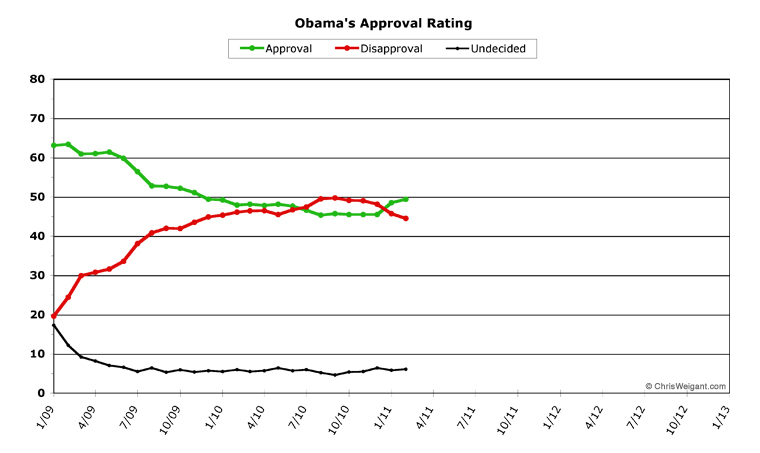
In January, President Obama had the biggest improvement in his public approval rating of his entire presidency. In February, Obama consolidated and built on his January "bump," by posting his second-most-improved month ever. This turnaround has set the clock back for Obama over a full year (in terms of his overall polling numbers), to roughly where he was in December, 2009. All in all, not a bad month for the president.

But that does come with a caveat -- Obama started the month strong, but then leveled off for the rest of February. His bump may well have "crested" this month, but even if this proves to be true, Obama looks most likely to plateau at the higher rate rather than falling back. In other words, he has successfully consolidated the gains in his approval rate over the past two months or so, rather than watching them bounce right back down.

Let's get right to this month's chart, so you can see what I'm talking about:

Obama Approval -- February 2011

[Click on graph to see larger-scale version.]

February, 2011

Continue Reading »

Where Are All The Republican Candidates?

[ Posted Tuesday, March 1st, 2011 – 18:08 UTC ]

We are now roughly twenty months away from the next presidential election. But, rather surprisingly, only one Republican has announced he's running for president -- and he's not exactly a "top tier" candidate. So one has to wonder, where are all the Republicans?

Don't get me wrong -- I'm not saying it is a bad thing (or, for that matter, a good thing) that the 2012 election cycle hasn't gotten off the ground yet. Presidential races, according to conventional wisdom, just get longer and longer by starting earlier and earlier each time. The joke right after the midterm congressional elections last year was that the next day was the kickoff for the '12 campaign. But the conventional wisdom has turned out to be wrong this time around. Because there is no "field" of candidates yet on the Republican side.

Exactly four years ago, in the winter of 2007, both major parties had a full slate of candidates. For the Democrats, everyone had already announced their candidacy, either formally or informally. The list of Democratic contenders, at the beginning of March, 2007, consisted of: Joe Biden, Hillary Clinton, Chris Dodd, John Edwards, Mike Gravel, Dennis Kucinich, Barack Obama, Bill Richardson, and Tom Vilsack. There were other names being bantered around as possible contenders (such as Wes Clark), but none of them wound up running in the end.

On the Republican side, all the heavyweights had already announced, as well as a few less-than-heavyweights. Their fringier candidates, for the most part, had held back and jumped into the fray later on, but in March, 2007, the following Republicans were already in the race: Sam Brownback, Rudy Giuliani, Mike Huckabee, John McCain, and Mitt Romney. Several other names were being batted around, some of whom went on to run and some of whom did not: Newt Gingrich, Chuck Hagel, Duncan Hunter, Ron Paul, Tom Tancredo, and Tommy Thompson. One vanity candidate jumped in the Republican race very late in the game, but Fred Thompson never went much of anywhere after he formally announced.

Continue Reading »

Obama Should Give Second Cairo Speech

[ Posted Monday, February 28th, 2011 – 17:58 UTC ]

President Barack Hussein Obama, on June 4, 2009, gave a speech in Cairo, Egypt. This speech was widely praised both in America and abroad when Obama delivered it, as being both an overture to the Muslim world and a redefinition of some key American policies in the region (or, at the very least, a respectful explanation of continuing policies).

That was then, this is now. Things, to put it mildly, have changed a bit. President Obama should realize the opportunity this presents, and should soon give a sequel to his first Cairo speech, because the situation on the ground is moving so rapidly in the entire North African and Middle Eastern arena. It will be tough for Obama to thread the needle on what the emerging American policy is towards the uprisings spontaneously erupting in so many different countries (with so many different political situations) -- because America has always dealt with the region's various types of government on a case-by-case basis, according to our national interests (which can be largely summed up as: "oil"). Also because the current situation is so fluid. But just because it will be a hard speech to write doesn't mean Obama shouldn't make the effort, as soon as is humanly possible.

Continue Reading »

Friday Talking Points [156] -- Fighting On Several Fronts

[ Posted Friday, February 25th, 2011 – 17:20 UTC ]

Well, that was a busy week, wasn't it?

We've got so much to cover this week, we're going to have to move pretty quickly here. In international news, North Africa and the Middle East are still seething. The American news media, however, are (I actually heard this phrase being used by someone with a blowdried haircut the other night on television) experiencing "revolution fatigue." Seriously. They're bored with the whole storyline. Another dictator fell? Crowds of unarmed people being machine-gunned? Yawn. Don't we have an Oscars story we could run, instead?

Sigh.

Right now, of course, the main story is Libya, but other countries Americans cannot locate on world maps are also clamoring for change. Including, very inconveniently, Iraq -- where crowds of unarmed protesters have been shot at with live ammunition. But dead protesters in our forcibly-imposed democracy in the region is just so not according to the media's storyline, meaning it didn't get much coverage.

Continue Reading »

Labor Shut Out Of Sunday Morning Talk Show Circuit?

[ Posted Thursday, February 24th, 2011 – 18:17 UTC ]

I realize that there is a lot going on politically this week, on the state level and on the federal level (both domestically and internationally). I should probably be writing today about President Obama's new stance on the Defense Of Marriage Act, or Libya, or Bahrain, or the continuing attack on abortion rights here at home, or budgetary matters, or the Tea Party Republicans' overreach, or whether the federal government is going to shut down or not next week. All worthy subjects for commentary, for obvious reasons. But there's a more immediate concern today involving the mainstream media, where I feel a few calls and emails are warranted to the big networks. Because the most pressing issue on the domestic front is what is happening in Wisconsin (and Indiana, and Ohio, and many other states). There are two sides to this story. One side is the governor of the state, and his fellow-travelers on the right, who are ideologically committed to the destruction of public employee unions. The other side, quite naturally, is Labor's view of the situation. But the fabled "gatekeepers" of the "serious media" have apparently decided that only one side of this story needs be told.

Continue Reading »

Big Brother v. Little Brother

[ Posted Wednesday, February 23rd, 2011 – 17:48 UTC ]

Everyone knows who "Big Brother" is, of course, because we all had to read George Orwell's Nineteen Eighty-Four at some point in our schooling. Big Brother is the fictional benevolent figurehead in Orwell's "negative Utopia" masterpiece, whose beaming visage is a front for a totalitarian police state which spies relentlessly upon its own citizenry. Television sets, in this future world, are both unavoidable and two-way -- broadcasting images of what you are doing in your own home to the government watchers. To some extent, Orwell's dark fantasy has become everyday life in some places (it's almost impossible to avoid being publicly filmed now in cities like London, for instance). But there's been a balancing revolution in surveillance as well -- which is more and more apparent in the recent news. I'm going to call this effect "Little Brother" -- citizens watching, filming, and reporting on governmental activities to a rapt worldwide audience. And we've already seen how powerful a tool this can be in the Middle East.

In ancient times -- say, twenty-five years ago or so -- the technology which caused this powerful effect either didn't exist or was in its bulky, heavy infancy. Small camcorders were becoming available which took video, but they were still rather expensive. So expensive (and bulky, for the most part) that most people who owned them didn't carry them around on a daily basis. Professional television and video cameras still weighed a ton, and were outrageously expensive, so they were still mostly the province of wealthy newsgathering organizations.

This limited what video was available to both the news organizations themselves, and to the wider public. The established media outlets were still firmly in charge of their "gatekeeping" function. The public only saw what a professional camera crew dispatched to the scene captured (whatever the scene happened to be). Or, at least, what parts of it were edited down for the evening news.

But twenty-five years, in technological terms, is several eons ago. First the internet burst onto the scene. Then blogging. Digital cameras became cheaper and cheaper, and more accessible. Cell phones became tiny, and affordable. Then cell phones merged with both the computer and the digital camera (still and movie), until you can now fit more technological power in the palm of your hand than was even available twenty-five years ago. What's more -- pretty much everyone could afford it. Which meant everyone with such a video-ready cell phone in their pocket became their own sort of "check and balance" on governmental powers -- and governmental abuses.

Continue Reading »