[ Posted Tuesday, April 12th, 2011 – 16:59 UTC ]
Exactly 150 years ago today, the Civil War began, when rebel forces began shelling Fort Sumter, South Carolina. The bombardment began at 4:30 in the morning, and continued for 34 straight hours. The fort must have been pretty well-built, though, since no Union soldiers died as a result of the onslaught. But plenty would die in the rest of the war, which remains America's bloodiest conflict. The war killed over 600,000 soldiers on both sides, as well as uncounted civilians.
There will be plenty of commemoration of this momentous event elsewhere today, though, so I merely mention it in passing. Because today is also another anniversary in American history, albeit one not nearly as momentous. Five years ago today, Massachusetts Governor Mitt Romney signed a bill into law which revamped the state's healthcare system. Nowadays, it is referred to (for better or worse) as "Romneycare."
As I said, I am in no way trying to equate these two events, and am going to avoid even trying to draw any metaphors between the two. Reforming healthcare is simply not in the same universe as a war between different regions of this country, in so many ways. The only thing the two share, in other words, is today's date. Just want to be clear about that, up front.
One person who (assumably) won't be celebrating the fifth anniversary of Romneycare is Mitt Romney himself. This is because the entire issue has become the biggest albatross around his neck, politically, as he tosses his hat in the 2012 presidential ring. So don't look for him to be cutting a "Romneycare fifth birthday cake" today. In fact, as far as Romney is concerned, it would be just fine if everyone conveniently forgot about the issue altogether.
Continue Reading »
[ Posted Monday, April 11th, 2011 – 17:21 UTC ]
President Obama has now called a "do-over" on his 2012 budget proposal. This news broke on the Sunday morning political television chat circuit, as the dust was settling on the government shutdown standoff for the remainder of the 2011 budget. Obama's move was prompted by the budget proposal put on the table by Republican numbers guru Paul Ryan, which seeks to "reform entitlements" by turning Medicare into a voucher system. Obama's new proposal will reportedly also offer "entitlement reform," although no specifics have leaked out yet. What the president should realize at this point, though, is that Ryan has just put him in the driver's seat. Ryan's proposal is so radical that it's going to be very easy for Democrats to present themselves as a more humane alternative to the Republican agenda, and it's going to be very easy for whatever Obama comes up with to look a lot better than just handing seniors a voucher and saying: "Good luck with that medical insurance marketplace."
Ryan's plan, no matter what you think about it, is being hailed as "bold," because it is the first time in a very long time that Republicans have actually put numbers on paper when talking about their budget priorities. Ryan's plan isn't all that new, actually, but when he introduced a similar plan last year, he only got about a dozen or so Republicans to sign on to it. Now that they're in the majority in the House, everyone is taking Ryan's plan a lot more seriously, it seems. Which is forcing the president's hand.
Obama was criticized for his initial budget proposal for not taking on the entitlement question at all. So he's going back to the drawing board and is expected to release his "2.0" plan later this week. It was leaked today that the White House is indeed going to include some entitlement reforms, and will also be raising taxes on the wealthy.
Continue Reading »
[ Posted Friday, April 8th, 2011 – 16:51 UTC ]
The American media lost interest in the war in Libya faster than they've ever done so before, not to even mention the eerie radioactive glow emanating from the milk aisle back home in West Coast grocery stores. Instead, they have been going bonkers all week over the prospect of a government shutdown situation. Will a deal be reached? Will the government shutdown? Will the media enjoy the living heck out of the whole thing? Yes! They will! And why shouldn't they? Their comfortable salaries, after all, are in no way dependent upon the Small Business Administration being open to help them with loans.
Sigh. What's depressing about the whole thing, to me at least, is how the entire knock-down-drag-out fight is merely the preliminary round. This whole government shutdown walk-to-the-brink-and-stare-into-the-abyss thing is nothing more than the warmup for the next budgetary battles -- which will be much bigger. The entire initial fight is about staking out ground for the next two fights -- raising the debt ceiling, and the 2012 budget. Nobody involved -- not the Tea Party Republicans, not President Obama, not John Boehner, not Harry Reid -- really cares all that much about how this particular round ends up. They're all stuck thinking: "If I give in now, they'll want more later" -- and they're all entirely correct.
But this is going to be a marathon, and not a sprint. Much to the media's glee, no doubt.
Continue Reading »
[ Posted Thursday, April 7th, 2011 – 17:14 UTC ]
The president and the newly-resurgent congressional Republicans at an impasse. Republicans put a bill on the table which was unacceptable to the White House, because of ideological "riders" added. The debt ceiling has to be raised. Republicans talk of reducing the size of government and deficit slashing. The president says they just want to make deep cuts in Medicare. The government shut itself down.
Does any of this sound familiar? These aren't today's headlines, they are from 1995, when President Bill Clinton and Speaker of the House Newt Gingrich were toe-to-toe. The more things change, it seems, the more they stay the same.
I was curious what the media said during the last government shutdown, so I dug out a few stories I'm going to excerpt today, as well as the speech Clinton gave explaining the shutdown to the nation. The news articles were from a paywall site, so I do not have links to them, but the speech is posted on CNN's site.
I thought it'd be interesting to take a look backwards today, as we all sit around waiting for the current impasse to come to a boil. What struck me about these bits of history was how easily they could have been written this week -- with only minor changes to the text, both sides are pretty close to where Newt and Bill were back then. The similarities are kind of eerie, actually.
Continue Reading »
[ Posted Wednesday, April 6th, 2011 – 16:42 UTC ]
In the midst of a budget fight not seen in Washington in over a decade -- with the possibility of a government shutdown looming -- it's interesting to see how the two men at the heart of the standoff seem to be the least fervent ideologues of either party. What this means for the negotiations themselves is anyone's guess, but it's hard not to see how uncomfortable both Speaker of the House John Boehner and President Barack Obama are at this sort of bare-knuckles game.
Continue Reading »
[ Posted Tuesday, April 5th, 2011 – 17:29 UTC ]
The Democratic National Committee announced today they had named Representative Debbie Wasserman Schultz as their next chairperson. She will replace Tim Kaine, who is leaving the post to run for the Senate in Virginia. This is an excellent choice for the D.N.C., and Wasserman Schultz should be welcomed to her new post by all Democrats who want to see their party succeed.
The D.N.C. is the official Democratic Party machine. Technically, it is the party. The choice of who leads the party apparatus is normally made on the basis of fundraising prowess, since in a lot of ways the D.N.C. chair is "Chief Fundraiser" for the party as a whole. But there's a secondary part of the job, where some party chairs can (at times) fall short of the mark, and that secondary job is defining the party's message to the public. Call it the party's "Chief Framer," for lack of a better term.
Continue Reading »
[ Posted Monday, April 4th, 2011 – 15:06 UTC ]
Obama slips back
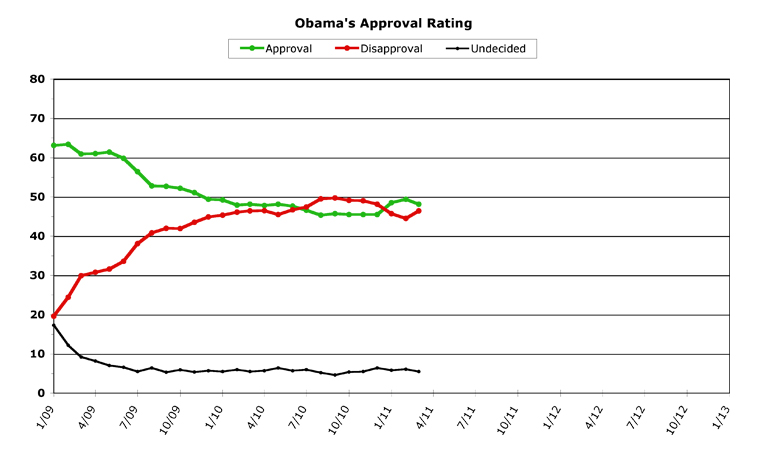
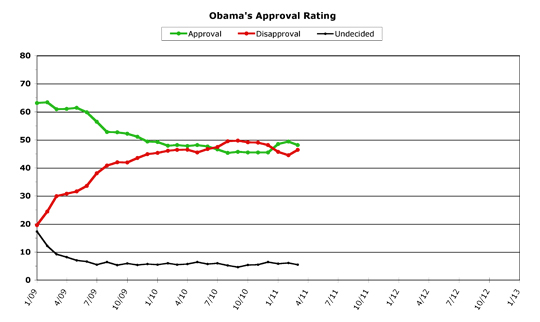
President Obama's poll numbers slipped back a bit in March, bringing an end to his recent "bump." This was Obama's first bad month in a while, ending the positive trends Obama had set for the past two months in approval rating, and for the past five months in disapproval rating. In March, Obama lost all the ground he had gained in February, but still finished the month up from where he started the year. In a statistical twist, Obama's approval and disapproval numbers for March, 2011 exactly matched his numbers for March, 2010.
Obama's actual peak in his daily numbers came around the beginning of February. Since then, he hit a plateau until the beginning of March, and then sank, rose, and sank again. Last month was a busy one, and this month proves to be just as eventful, but as Obama enters April, the trendlines have turned decidedly negative. This could lead to Obama losing all the ground he gained in his first-ever sustained chart bounce, which began around last December. Of course, because April will be eventful, Obama's numbers could also recover, depending on what happens in the next few weeks.
Let's take a look at Obama's monthly averages:
[Click on graph to see larger-scale version.]
Continue Reading »
[ Posted Friday, April 1st, 2011 – 16:47 UTC ]
To clarify that title: when you pull a prank on this particular day, you're supposed to reveal yourself as the prankster by yelling "April Fools!" (or even, as a purist might insist, "April Fools'!"). I am not doing so, hence the absence of the exclamation mark. Sadly, my task is today is not to prank anyone (I did that last year and promised I wouldn't do it again), but to catalogue the recent spate of foolishness from our national political arena. A sober list of the fools of April, rather than an excited "April Fools!" gotcha, in other words. Well, maybe not all that sober. You decide.
Speaking of foolishness, I have to begin by admitting how big a fool I am. This week, I was supposed to announce the winners of last week's "Name That War" contest. I fully intended to do so, but then when I sat down to write today, I was so consumed by all the other foolishness that I plumb forgot about judging the contest. I sincerely apologize for being this sort of a forgetful fool this week, and by way of compensation declare that the contest is still open (go read last week's article for context) and we'll still be accepting suggested replacements for (shudder) "Operation Odyssey Dawn" this week. Mea culpa all around, as well.
Continue Reading »
[ Posted Thursday, March 31st, 2011 – 16:01 UTC ]
The media is currently obsessing over the prospects of a government shutdown next Friday, and over the congressional budget negotiations currently taking place which could prevent it from happening. But this is a relatively small fish to fry, because the real budget battle will be officially joined next Tuesday, when Republican Paul Ryan unveils his budget plan for 2012, complete with 10-year projections. What is currently being debated pales in consequence to the fight over the 2012 budget, although it may take the media a while to realize it, because it is so much more fun to say "government shutdown" in a scary voice on television.
What Congress is currently squabbling over is passing a budget for the next six months. The House Republicans want $60 billion in cuts, the Senate Democrats have offered $30 billion, and rumors are that a deal has been struck in the range of $33 billion which could pass the Senate and the House. Note I said "could," as nothing is certain at this point.
But these negotiations are going to pale in comparison to the GOP's proposed budget for next year. President Obama has already put his proposal on the table. Republicans scoffed at it because it "didn't take on entitlements" and "has unacceptable deficits" in it. Next Tuesday, they're going to put their own plan on the table. If reports are to be believed, they also will not be taking on the subject of "fixing Social Security" because some of their members begged them not to (realizing what their constituents would likely have to say about it). But the rumors are even stronger that their budget plan will indeed take on Medicaid and Medicare in a significant way.
Continue Reading »
[ Posted Wednesday, March 30th, 2011 – 16:13 UTC ]
The Tea Party Republicans in the House of Representatives are supposed to -- according to their own statements -- absolutely revere the United States Constitution. They even opened their current congressional session by reading the whole text of the document aloud (or, at least, the non-embarrassing parts of it). So it's a little surprising that they appear not to understand one of the bedrock ideas enshrined within the Constitution -- how a bill becomes a law. House Republican leaders have announced they'll be voting on a bill this Friday (charmingly entitled the "Government Shutdown Prevention Act"). This bill reportedly contains a piece of legislative fantasy within it -- that the House of Representatives can declare something to be the "law of the land" without any input or action from either the Senate or President Obama.
Continue Reading »