[ Posted Monday, July 18th, 2011 – 15:24 UTC ]
Since it's been over a month since we last took a look at how the 2012 Republican presidential field is shaping up, we're overdue for an update. Or, quite possibly, I am just tired of writing about the Kabuki theater nature of the debt ceiling debate, which looks to continue for at least another week... sigh. In any case, let's cast an eye over the Republican nomination landscape and see what there is to be seen, shall we?
In the past few weeks, one rising star has appeared in the Republican firmament (or two, depending on how you count them), and more than a few have begun fading -- perhaps permanently -- from center stage. But the field itself is not yet set (in terms of who is actually running and who will sit this one out), as the Republican Party continues to search for the perfect candidate to defeat President Obama. In fact, two of our four frontrunners this time around have not even announced their candidacy yet -- showing how volatile the entire race still remains.
Continue Reading »
[ Posted Friday, July 15th, 2011 – 16:50 UTC ]
Are we seeing the new model of Barack Obama's presidency? Is this (in the parlance of Silicon Valley) "Obama 2.0"?
This seems to be a large point that all the overanalysis of rumors in the past few weeks has largely missed. Partisans on both sides have been kept busy having fits of the vapors over unconfirmed (and, for the most part, unsourced or anonymous) rumor leaks about what is "on the table" in the debt ceiling negotiations, while the media is content to sit back and fan the flames. In the midst of this frenzy, nobody seems to have noticed that President Obama is negotiating in a markedly different way than what we've seen from him in the past. Obama is at the absolute center of the showdown, he is using the bully pulpit for all its worth, and he has not (so far, unless you choose to believe this rumor or that) backed down on a few key "lines in the sand." All of this is nothing short of a sea change from how Obama handled (for example) the healthcare reform battle.
Since there is no agreement yet -- no grand "deal" has emerged from the talks between the White House and congressional leaders -- I'm going to wait to discuss the particulars of such a deal until it actually... you know... exists. I realize I am jeopardizing my standing among my peers by doing so, because apparently I'm supposed to be fulminating about whatever is the current rumor du jour right about now, along with the rest of the pack. Instead, I'd like to focus on the process, and the way President Obama has conducted himself in the negotiating process.
Continue Reading »
[ Posted Thursday, July 14th, 2011 – 16:46 UTC ]
Yesterday, I wrote an article which attempted to goad mainstream "journalists" into doing some basic research on the historic parallels between the all-consuming debt ceiling negotiations and what happened back in 1995 and 1996 between then-President Bill Clinton and then-Speaker of the House Newt Gingrich. At the bottom of the article, I appended a note which apologized for the lack of links to the source articles I had used in my own research. Because I obtained these articles through a pay site (LexisNexis), I could not easily link to them for my readers.
Today, I'd like to excerpt some of those articles, as "footnotes" to yesterday's column. While copyright laws prevent me from just pasting whole articles in here, I am allowed fair usage excerpts, which is what you'll find below. The promise of the internet was supposed to be easy access to this sort of thing, but in recent years many media sites have locked off their archives behind paywalls, making it impossible to freely access this historical material.
Continue Reading »
[ Posted Wednesday, July 13th, 2011 – 16:17 UTC ]
I've always been astounded at the near-complete lack of historical memory regularly exhibited by both Washington politicians and the "journalists" who purport to cover them. Nothing I've seen in the past few weeks has caused me to change this opinion, either, as the fight over raising the federal debt ceiling has played itself out.
While it's certainly understandable that subjects such as the Smoot-Hawley Tariff or the Greenback Party would be considered so obscure and so removed from living memory as to be ignored, there is simply no excuse for ignoring a direct parallel to today's political news which happened only two presidents ago. Because we've been here before with the debt ceiling. Well, not precisely where we find ourselves at in 2011, but close enough to the government shutdown in 1995-96 that multiple parallels can easily be drawn.
Back at the end of 1995 and the beginning of 1996, we had a Democratic president in the White House, and a Republican House of Representatives. Then, as now, we had a huge political showdown over not only the issue of the federal budget, but also over raising the debt ceiling. Then, as now, the two separate issues had been locked together legislatively, at the demand of the Republicans. Then, as now, the president would have much preferred a "clean" debt ceiling bill. Then, as now, the biggest threat was the United States defaulting on its debts. Then, as now, one of the biggest bones of contention was proposed Republican cuts to Medicare. Then, as now, we had a bunch of radical Republican freshmen in the House. Then, as now, a presidential election was right around the corner, and both sides were jockeying for political position.
Continue Reading »
[ Posted Tuesday, July 12th, 2011 – 17:28 UTC ]
A "light bulb moment" is, of course, when a new idea strikes. The name comes from the cartoon image of a person (often blurting out "Aha!" or even "Eureka!") at the very moment the idea strikes -- pictured with a glowing light bulb over their head. However, while this serves as a clever headline for today's column, this is not your typical light bulb moment, for a number of reasons. The most ironic of which is that the light bulb, in today's debate, is now the old idea that is under attack. Or, perhaps, "was" under attack, as now the Republicans have turned the tables and are defending the traditional light bulb and attacking the new idea. If this sounds confusing, I promise we'll get to the politics in a moment. First, a short synopsis of where we stand today.
I should begin by saying that if you have no idea what I'm talking about at all, you are in good company. Most Americans don't even know there's a light bulb debate happening right now in Congress. If you live in California, however, you likely have already realized what is going on: standard light bulbs are being effectively banned.
Continue Reading »
[ Posted Monday, July 11th, 2011 – 16:21 UTC ]
The entire political world right now is holding its collective breath over whether a deal will be struck between President Obama and the leadership of Congress to raise America's debt ceiling. The more honest observers of this process have noted the "Kabuki theater" nature of the proceedings, as they wisely discount the possibility that the deadline will be reached with no agreement in place. "This is all for show," the jaded pundits assure us, "there will be a deal." But this reasoning can be taken one step further: not only will there be a last-minute deal, but the deal will not happen until that last minute -- and this is by design. While duelling press conferences amuse the public, behind the scenes the name of the game Obama and the Republicans are playing could rightly be called "The Big Stall."
Continue Reading »
[ Posted Friday, July 8th, 2011 – 15:44 UTC ]
The silly season has come early to Washington, it seems. The root cause is a simple fact of American politics these days -- sometimes, there just can't be transparency. That's a fairly provocative statement, so allow me to explain my reasoning in detail. Then, later on (in the talking points section of our program), we'll get into the option of the Fourteenth Amendment to the Constitution, and how Obama should be using it right about now. But for now, it's time for a sober assessment of where Washington currently stands.
Once again, national politicians are in negotiations over a key piece of legislation which, if it does not pass, will cause doom and gloom across the land. Once again, "journalists" are reduced to mere purveyors of increasingly wild and rampant speculation, for weeks on end. The key underlying fact is ignored by virtually everyone, in the midst of this frenzy: this is not some sort of aberration, this is how Washington gets anything done. At least, these days.
Continue Reading »
[ Posted Thursday, July 7th, 2011 – 18:38 UTC ]
Due to circumstances beyond our control, there will be no column today. We apologize for the interruption in service. Columns will resume their normal schedule starting tomorrow.
-- Chris Weigant
[ Posted Wednesday, July 6th, 2011 – 13:21 UTC ]
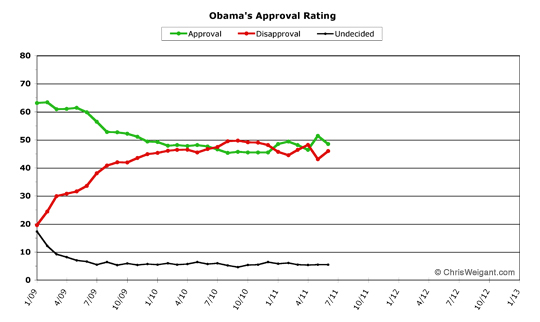
[Program Note: Last month, we ran this column four days before the end of May, due to travel plans. We promised we'd update the preliminary numbers if they had changed at all due to the last four days' worth of data. As it turned out, we got lucky, and none of the numbers needed adjustment. The final numbers in May were the same as we reported in our preliminary column -- Obama charted a 51.4 percent approval rate, and a 43.1 percent disapproval rate, which left 5.5 percent undecided.]
Bin Laden Bounce Disappears
As many were predicting, President Obama's bounce in approval polls due to the death of Osama Bin Laden did not last very long. While Obama started the month still strongly riding the wave of public approval from the Bin Laden raid, this had mostly dissipated by the second week in June, and Obama's poll numbers flattened out after that. The plateau he hit at this point is slightly higher than he had before the "OBL bump," but that's about the only consolation for Obama fans in the June numbers.
All told, Obama's numbers took a bigger dive in June than he has had to endure for almost two years (since August, 2009). But, when looking back at the data through the lens of history, the past two months will be seen as a polling anomaly, where Obama's numbers shot up, then settled back down, all due to one single event.
Let's take a look at the updated chart:
[Click on graph to see larger-scale version.]
Continue Reading »
[ Posted Tuesday, July 5th, 2011 – 16:50 UTC ]
The mainstream media love to use opinion poll numbers to highlight the American public's disapproval of certain persons and institutions. But there's one poll number they never seem to get around to adequately reporting: their own. There's a reason for this, and it is a simple one. The media doesn't report their own poll numbers because their poll numbers stink, and it's less embarrassing to just ignore this fact rather than to report it.
A wire report today confirmed this, once again. This story focused on new Gallup poll numbers which showed public confidence in newspapers at 28 percent, and in television news at 27 percent. But while the wire report attempted to put these numbers in the brightest possible light, the fact remains that poll numbers this dismal show that roughly three-fourths of the public doesn't have much (if any) confidence in the news media.
Continue Reading »