ChrisWeigant.com

Friday Talking Points [353] -- Donald Trump, Frontrunner

[ Posted Friday, July 10th, 2015 – 16:25 UTC ]

Yes, it's strange but true -- Donald Trump is now a frontrunner for the Republican nomination for president. That's a pretty breathtaking place for the Republican Party to find itself in, isn't it? But it cannot be denied. Trump is sucking so much oxygen from the nomination race, it's a wonder any of the other candidates are still drawing breath. Trump is not only the major subject all other candidates get asked about in interviews, he's also been climbing in the polling. Oh, sure, some of that is likely just name recognition, but not all of it. Like it or not (for the Republican Party), Trump's views on immigration are resonating with a certain slice of the party's base. This doesn't exactly bode well for any attempt by the Republican Party to reach out to Latino voters, of course.

In other news from the Republican race, apparently 16 candidates is not enough. One more Republican announced he's considering a presidential bid, which the Huffington Post reported with the amusing headline: "Former Virginia Governor Jim Gilmore To Run For President Because Why Not" (funniest one we've yet seen in the 2016 race). Heck, why not 18? Or 20? The more the merrier!

Continue Reading »

The Trump Party?

[ Posted Thursday, July 9th, 2015 – 16:59 UTC ]

Donald Trump is truly the gift that keeps on giving. For Democrats, that is. Democrats wake up every day to hear what Trump has recently said, and it's like a big old birthday present each time.

Today, a new interview ran in the Washington Post. Their editorial staff got to sit down with Trump for a half-hour, and of course there were the usual amusing bon mots from Trump, including his impression of Mitt Romney in the debates, last time around. Romney, Trump said, was overhandled and overrehearsed, or as The Donald put it: "He became a frozen jellyfish. He spent so much time in prep he couldn't speak." Say what you want about the man, but he does come up with some great metaphors from time to time. Mitt Romney as "frozen jellyfish" is an image it'll be hard to forget, actually.

Continue Reading »

Hillary's Rope Trick Getting A Bum Rap

[ Posted Wednesday, July 8th, 2015 – 17:15 UTC ]

The American public has a pretty high level of seething contempt for politicians. However, this is easily matched (if not surpassed) by the level of seething contempt the public also holds for journalists and the news media. I mention these two facts because whenever the media inserts itself into a story (or "becomes the story"), they usually are astonished that the public doesn't see them in the quite the sympathetic light they're aiming for. Which brings us, in a roundabout way, to the story of Hillary Clinton's rope trick.

If you haven't heard the story yet, you must not pay much attention to politics or the news in general, because it's been all over the place since last weekend. Hillary Clinton, as presidential candidates are wont to do, participated in a July Fourth parade in a town in an early-primary state. The press was invited to cover the parade. Which they were fully able to do. Instead of Team Hillary positioning groups of the media at static points along the parade route, they even allowed the media to walk in front of Clinton along the parade route. But there was a problem. To keep the journalists and photographers moving, Clinton aides stretched a rope across the street and walked it forward, to prod the journalists to keep up a decent pace. It was, after all, a parade, and nobody likes a parade which repeatedly grinds to a halt.

Continue Reading »

Trumping The Debates

[ Posted Tuesday, July 7th, 2015 – 15:28 UTC ]

Is Donald Trump the new face of the Republican Party? While this notion would have seemed downright ludicrous a few months ago, it is now being seriously contemplated on both sides of the aisle. Granted, Democrats are a lot happier about this prospect than many Republicans are, for the simple fact that it leads to the question of what a debate with Donald Trump in it is going to sound like -- which is pretty much a dream scenario for Democrats and a nightmare for those Republicans who care about the future direction of their party.

The first debate isn't all that far in the future. The rules, as stated, are that any Republican polling in the top ten in nationwide will be allowed onstage, while the other six (assuming Scott Walker and John Kasich jump in) will be shut out. Currently, Trump easily clears this hurdle while people like Carly Fiorina and Lindsey Graham do not. This has already led to handwringing among the Republican Party bigwigs, some of whom are beginning to hint that it might be better if they somehow tweaked the rules to blatantly shove Trump off the stage. It's hard to see how such blatant cherry-picking could be seen as acceptable, especially considering what Trump himself would have to say about such an arrangement (my guess is he'd have a slight problem with getting shut out, and wouldn't be shy about saying so).

Continue Reading »

Hillary And Bernie

[ Posted Monday, July 6th, 2015 – 16:10 UTC ]

The Democratic presidential field is shaping up into a one-on-one contest, at least at this early stage of the race. While Jim Webb, Martin O'Malley, and Lincoln Chafee are all now official candidates, none of them has managed to either distinguish themselves much or garner much of any voter support. Which leaves Hillary Clinton and Bernie Sanders as the only two candidates capable of pulling in double-digit polling numbers among Democratic voters. Well, to be absolutely accurate, there are three Democrats who routinely manage this feat, but so far Joe Biden hasn't indicated whether he'll run or not. For now, it's Hillary versus Bernie, and the next few weeks could considerably sharpen up this contest.

I say this for two reasons. The first is that Hillary Clinton seems ready to come out of her shell. She's about to do her first interview with the national media, having previously only given local media interviews. More importantly, perhaps, she's also about to get a lot more specific about her economic agenda. More on this in a moment. The second reason I'll be closely watching the next few weeks is that Bernie Sanders is finally getting some media attention of his own. They can't ignore him any more, since he is pulling in the biggest crowds of any candidate running (from either party). Something is quite obviously happening out there, and some in the media are beginning to actually admit this fact (albeit reluctantly, and often dismissively).

Continue Reading »

Friday Talking Points [352] -- Always Twirling For Freedom!

[ Posted Friday, July 3rd, 2015 – 17:35 UTC ]

It's officially a holiday since tomorrow's the nation's birthday and all, but since this column took a vacation last week, we thought we'd better get a new column out today. After all, it's been an eventful two weeks!

Continue Reading »

Candidate Fatigue

[ Posted Thursday, July 2nd, 2015 – 16:43 UTC ]

This week, the 18th and 19th people running for president announced their candidacies. Chris Christie became the 14th Republican candidate running, while Jim Webb became the fifth Democrat to enter the race. These announcements won't even be the final ones of this election cycle, as everyone fully expects both Scott Walker and John Kasich to also throw their hats into the Republican ring. I have to admit, though, that the sheer number of candidates has worn me down. I have what could be called "candidate fatigue" at this point. It's tiring even keeping track of this big a pack, and even though the campaign has barely begun in earnest, I'm already exhausted.

Continue Reading »

Obama Poll Watch -- June, 2015

[ Posted Wednesday, July 1st, 2015 – 16:43 UTC ]

A volatile month

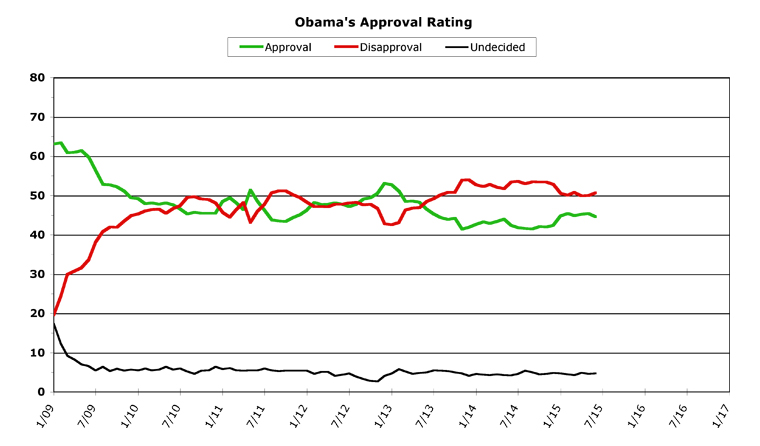
June was a busy month for President Obama's job approval ratings. Lots of things were happening during the month, good and bad, and Obama's approval rating swung through an initial steep decline, but then at the end of the month experienced a spectacular recovery. What July will bring is anyone's guess, in other words. Obama wound up down for the month when the monthly averages were calculated, but they could very easily go right back up again in July. Here's our updated chart.

Obama Approval -- June 2015

[Click on graph to see larger-scale version.]

June, 2015

Continue Reading »

Nonpartisan Redistricting Wins

[ Posted Tuesday, June 30th, 2015 – 16:59 UTC ]

The Supreme Court issued their last rulings of the season yesterday, and I thought one ruling kind of got short shrift by the media. Granted, there were other big rulings on the same day (the court usually saves their biggest cases for last, but this year they actually released the two biggest decisions last week) involving E.P.A. regulations and the death penalty, but the redistricting case -- to me, at least -- was more important.

I have to admit I'm biased, because I live in California. While the case before the high court only directly involved Arizona, California likely would have been affected soon after. Which is why I'm breathing a sigh of relief that the court ruled the way it did. California has a similar system as the one in question in the Arizona case, and I both voted for it and strongly support it.

At the heart of the case was a voter revolt over gerrymandering. Gerrymandering is, of course, the practice of cleverly drawing districting lines so that your political party benefits, far out of proportion to actual voter support. Pennsylvania, for instance, voted for President Obama twice -- by 55 percent in 2008 and 52 percent in 2012. The state has voted for Democrats in all six of the past presidential elections, in fact. But their delegation to the House of Representatives is composed of 13 Republicans and only five Democrats. That's pretty lopsided, and doesn't even come close to representing the state's partisan divide. If the state's voters accurately reflected their House delegation, 72 percent of Pennsylvania's voters would have voted Republican.

Continue Reading »

From The Archives -- SCOTUS Optimism

[ Posted Friday, June 26th, 2015 – 16:49 UTC ]

Program Note: I'm on vacation today and Monday. Due to the breaking news this morning, I thought I'd run this column again, despite the fact that it originally ran only three weeks ago, on June 8. Call it my own personal victory lap if you will.


For political wonks, June is not the month to celebrate grads, dads, and brides, but instead the biggest SCOTUS month of the year. SCOTUS (for the un-wonky) stands for "Supreme Court Of The United States." June marks the end of the Supreme Court's yearly session, and it is when all the biggest decisions get handed down.

This year, there are many important decisions we'll be hearing about all month long, but the biggest two (or the two with the biggest political overtones, at any rate) will likely be held back until the very end of the month. They are Obergefell v. Hodges and King v. Burwell. The first will settle once and for all the question of marriage equality for same-sex couples, and the second will determine whether millions of Americans will lose their health insurance subsidies or not.

Now, guessing which way the court will rule is always a risky proposition. Some even call it a fool's game. Nevertheless, I'm going to go out on a limb today in a burst of (perhaps) foolish optimism, and predict that both decisions will actually be good news. We've already seen a flurry of "sky is going to fall" stories (especially over King) from liberals in the media, and my guess is that this trend is only going to increase, the closer we get to the end of the month. So I thought one article from a more optimistic perspective might be appreciated -- even if my guesses turn out to be utterly wrong, in the end. That, of course, is always the risk you run when going out on a limb during SCOTUS season. Time will tell whether I'm right or wrong, but for now, here's my take on these two cases, seen mostly through the lens of politics.


Obergefell v. Hodges

This is almost a case study (pun intended) of how the Supreme Court really likes to decide very contentious social issues in as gradual a fashion as they can get away with. The Obergefell case is going to be the culmination of the process begun by two earlier cases, United States v. Windsor and Hollingsworth v. Perry. These previous cases legalized some gay marriages and threw out a state-level "defense of marriage" law (which had been passed by Californian voters) as unconstitutional. However, the Supremes declined to unequivocally state that marriage was a constitutional right for gay couples across the land. What this meant was that each of the two decisions had very limited effect, at least at first.

The lower courts, however, saw which way the Supreme Court was heading, and they began striking down "heterosexual only" marriage laws in state after state. This has brought gay marriage to around three-fourths of the states, but it is not yet universal across all of them. After dozens of state laws were struck down, finally one federal court ruled for such laws, which set up the confrontation which brought the case back to the highest court in the land.

This was all pretty much by design. John Roberts didn't want to impose gay marriage on the whole country all at once, when (at the time) only a relative handful of states had legalized it. So the decisions were written very narrowly, to give the country time to get used to the idea, and to offload much of the contentiousness on the lower courts.

This is a fairly normal way for the high court to partially dodge a contentious issue, it must be stated. What is astonishing is how fast the whole process played out. The two previous court decisions were handed down in June of 2013, and at the time I guessed that it'd be at least five years before the Supreme Court would revisit the issue. Instead, it has been only two years -- lightning speed for the judiciary on any such politically contentious issue.

But no matter the intervening gap, it's pretty easy to see what's going to happen in Obergefell. John Roberts can now act in a much more bold fashion, secure in the knowledge that the court will only be changing laws in a small number of states. Of course the Supreme Court is supposed to be all about the law, and never about politics, blah, blah, blah. But this is simply not reality, and probably never was. Justices know that there are real-world implications from what they decide, and this is most important to the Chief Justice, since his name is on the court (e.g., the "Roberts court" or the "Warren court").

This is why I predict a 6-3 victory for marriage equality. Not only will the "swing vote" (Anthony Kennedy) side with the liberals on the bench, but Roberts himself -- mindful of being seen "on the right side of history" -- will also somehow find a way to proclaim a constitutional right for same-sex couples to be married. This may generate a political backlash, but the legal question of marriage equality will be completely settled forevermore.


King v. Burwell

This case may determine the ultimate fate of the Patient Protection and Affordable Care Act, a.k.a. "Obamacare." The case hinges on a typo, in essence. On one page of the law, the language refers to only "the state" when discussing who is eligible for subsidies for health insurance bought on the exchanges set up for that purpose. It didn't also say "or the federal government's exchange," in other words.

Even one Republican on the drafting committee for the law has publicly stated that this was nothing more than a typo or oversight in the language being drafted. It was not intentional -- it was never supposed to be a way to punish states who didn't set up their own exchanges.

So the Supreme Court has two easy ways to rule on the case. They could either say "the letter of the law is the law, period," and by doing so put in jeopardy subsidies for over six million American families, or they could say "when you read the entirety of the law, it is obvious and clear that this is nothing more than a typo," thereby upholding the subsidies and keeping Obamacare intact. These are going to be the main arguments both for and against the decision, whatever it turns out to be. It all depends on how many votes each one of those arguments will get.

There is plenty of precedent for both arguments. There are too many cases to even bother citing where the court ruled that the overall intent of the law is the determining factor, not one badly-worded phrase. Many of these decisions were quite conservative in nature, in fact (the liberal side lost the case, to put it another way). So any of the justices could come up with a rationalization for voting either way, really.

Since there are two clear legal paths for them to follow, I have to assume that politics will play an enormous role in which way each individual justice votes. This may sound pessimistic to some readers, but I prefer to see it more as accepting the reality of the situation.

All is not lost, however, by admitting this. As with many cases, it likely means there are four solid votes in favor of preserving Obamacare subsidies for all, and three solid votes against. Kennedy and Roberts are the two unknowns.

But, once again, I'm taking an optimistic view. I think that there's a strong possibility that Kennedy will vote with the conservatives, but I also think that John Roberts is going to surprise a whole bunch of people by becoming the deciding vote in favor of upholding the subsidies. Roberts has already had one chance to disembowel Obamacare, and -- importantly -- he chose not to take it. The legal reasoning he had to use to justify this was pretty strained, in the earlier National Federation of Independent Business v. Sebelius case. In King, however, he can use very straightforward reasoning that has plenty of legal precedent behind it, which will only make it easier for Roberts to side with upholding Obamacare.

Roberts knows that if he guts Obamacare, his court will long be remembered for dismantling a president's signature political agenda item. History has not been kind to Supreme Courts who have done so, for the most part, because it is seen as so nakedly political.

If Roberts were an actual ideologue bent on overturning Obama's signature law, then why didn't he do so already? The earlier case would have completely obliterated Obamacare, and yet Roberts chose not to do so. This is why I am optimistically predicting he will, once again, choose not to do so. Roberts knows the legal reasoning behind the challenge to Obamacare is weak. In fact, it would overturn a long list of precedents and set a new standard that will be very hard to justify in other (less political) cases.

So my prediction for King v. Burwell is that the court will rule 5-4 in favor of interpreting the law as being equal for all U.S. citizens, no matter what state they may reside in. I could even see this one going 6-3 as well, but have a sneaking suspicion that Kennedy will vote with the conservatives on this one. The court has already declined once to kill off Obamacare by judicial fiat, and I don't think it's going to do so on King either. Of course, I could always be wrong, so we'll just have to wait a few weeks to see what SCOTUS actually does decide. For now, I remain cautiously (and, perhaps, foolishly) optimistic.

-- Chris Weigant


Follow Chris on Twitter: @ChrisWeigant